This past weekend, my wife and I headed out for our last weekend of camping on the Denali Highway. The weather the last few weeks here in our part of Alaska has been awesome! We were hoping to squeeze in one last trip with our new travel trailer before we winterized it. It was also the last weekend for the Polar Bear Club to have their last summer event. I thought this was a great opportunity to enjoy some of the great Alaskan outdoors and also do a bit of QRP portable operating. We headed out Saturday and planned on returning home on Sunday.
I did a bit of the Feld Hell Club's Hiram Sprint and while I was making trips around getting the trailer ready, I was calling CQ now and then. Before the contest ended, it was time for us to depart. We had an uneventful trip out to where we were going to camp for the night. I got the trailer set up and it was not long before I heard signals on the air, most being those operating the Washington State Salmon Run contest (CW of course). It sounded pretty good but my operating would be short lived.
After getting my station set up, I found I had an extremely high SWR on my portable antenna. I had never before experienced this issue with my Buddipole so I began to try different configurations and troubleshoot my problem. I was not making much headway before being interrupted by a passing motorist who had an apparent flat tire (pretty much shredded). It was a young gal who was traveling by herself and after stopping her car not far from our trailer, she came walking back to my location asking for assistance.
The Denali Highway is mostly non-paved and is very well known for damaging many hundreds of tires each summer. I don't feel comfortable driving on the highway with only one spare, let alone none! And this was the case of this gal from California. She was driving a small Datsun 280Z, 1980's vintage, and she had no spare tire, or jack for that matter!
To make a long story short, I spent quite awhile getting to the point where I could get her car jacked up and her tire removed. She was able to flag down a passing motorist and catch a ride to Cantwell. A few hours later, she returned with a new tire on her rim. I assisted her with putting the tire back on her vehicle and getting her on the way.
After watching this very nice gal from California drive off, it was only a matter of minutes when I saw a truck pull off of the roadway behind where we had been camped. Turns out, it was a co-worker of mine! He was out enjoying the nice weather and was looking for photo opportunities. I chatted with him as we watched the sunset and after he left, I spent the rest of the evening with my wonderful wife and our family beagle.
The next morning, I enjoyed the sunrise and once everyone was up and had breakfast, we decided to head on our way. I opted not to operate as we had a schedule to keep due to a busy week ahead. Things did not work out as planned for me, but my plans worked out for someone else. I was able to help someone in need on the Denali Highway. We made it home without any tire events but I hope to do some operating as Polar Bear 197 in the coming winter months. We have winterized our travel trailer but after I get my antenna issue resolved, I will hopefully be back on the air as /P with my QRP signal from some place in or around Denali. You may wonder why I mentioned Peanut Butter in my title and that was going to be my sandwich of choice while I was operating. That was replaced with a warm, sit down supper with my wife and our dog (who you see in the photo above). I may not have PB&J on my next adventure but I will for sure have my radio!
Tuesday, September 21, 2010
Saturday, September 11, 2010
Raining CQ Wallpaper
In checking our mailbox this weekend, I once again found a large white envelope addressed to my station. It was for my operational effort in the 2009 CQ World-Wide DX Contest - CW of course. Since my strongest band is 20 meters, I often enter the Single Operator, Single Band, 20 meter category. There are several categories but this one by far allows me to take full advantage of my strongest band, assuming propagation allows it. In looking back at my 3830 submission I see I wrote the following after the contest;
CQ Worldwide DX Contest, CW
I obviously busted a few callsigns but that is sure easy to do when my CW is not the very best at higher speeds. But, contesting is a great way to better your operating skill. As we well know, the bands aren't always 599 all the time. I like the challenge as it helps me become more familiar with propagation, filters in my Icom, and just dealing with multiple stations calling me at once, which tests my mental filtering ability. I prefer to park and call CQ and manage stations rather than search and pounce but if my run totals fall low, I'm turning the VFO! The Alaska contest group here have been very helpful in providing me with operating tips which is crucial in this propagationally challenged part of the world.
With the help of contests, I have been able to achieve my WAS (Worked All States) on the 3 major modes (SSB, RTTY, and CW) not to mention my DXCC, which I will be submitting for here in the coming weeks with my LOTW contacts. My hopes are to continue my quest at operating the major contests this coming winter as there is not much more to do when it's 30 below outside and dark. I would love to have a "golden log" which I have yet to achieve. But, with goals and hard work, I'm sure it's possible. Gives me something to work for but either way, I'm proud to hang another CQ certificate on my wall of the shack. QRZ?
CQ Worldwide DX Contest, CW
Call: KL8DX
Operator(s): KL8DX
Station: KL8DX
Class: SOSB/20 HP
QTH: Alaska
Operating Time (hrs): 26
Summary:
Band QSOs Zones Countries
------------------------------
160:
80:
40:
20: 1646 27 70
15:
10:
------------------------------
Total: 1646 27 70 Total Score = 355,990
Club: North Coast Contesters
Comments:
This contest has it all, from excitement to frustration. My original
goal was to work an all band entry but that changed on Friday. Seems
our constant weather pattern as of late has been low pressure after
low pressure from the Gulf of Alaska. As it works its way into the
Interior, along comes the strong winds that accompany it. That kept
me off the low bands on Friday and I opted to start then as a 20 meter
single band. As the weekend progressed, the winds died down but I
decided to keep my pace on 20 and only QSY'ing for those that requested.
And as I write this, we are just now feeling the effects of yet another
storm forecasted to bring 75+ mph wind gusts over the next 48 hours.
Many great highlights and lots of on air friends encountered. I'm
still a greenhorn at pile-up management but had fun so I appreciate
the patience of everyone. Add in northern latitude conditions, some
interesting echo effects from signals, it can make for some really
tough times picking out a callsign, or even parts of a callsign.
Band conditions were pretty good into Europe this first night but even
with high power, it took some calling. The second night, the path over
the North Pole was far from good and it seemed like the only good
propagation from Alaska was into Zone 33. I was excited to snag 35
though which was surprising! Nothing heard toward Europe on 15 meters
from my station. As for anything toward Asia, I normally work them
off the back of my beam so a few more repeats are sent their way.
I kept checking 10 meters and I did not hear a peep on that band all
weekend. Tried one QSY to 10 but that yielded nothing. I also tried a
few QSY attempts on 15 but I got skunked there as well. On Sunday, I
kept getting several dupes so I confirmed my suspicions after the
contest and found a station posted me as KL7DX and not by my actual
callsign. It happens frequently.
I will update my blog with more contest details but in summary, this
turned out to be my best effort ever in a contest. Not much by contesting
station standards but from my small station, I'm excited to once again
reach another goal and milestone in my casual contesting career. I have
received lots of great information from the Alaska DX - Contest group
for which I am deeply appreciative.
Thanks again for the QSO's and may the holiday season bring you joy, good
health, happiness, and of course, plenty of DX.
73,
Phil KL8DX
Denali National Park, Alaska
Radio: Icom 756PRO
Antenna: Mosley TA-34-XL @ 43 feet
Amp: Ameritron AL-1500
I obviously busted a few callsigns but that is sure easy to do when my CW is not the very best at higher speeds. But, contesting is a great way to better your operating skill. As we well know, the bands aren't always 599 all the time. I like the challenge as it helps me become more familiar with propagation, filters in my Icom, and just dealing with multiple stations calling me at once, which tests my mental filtering ability. I prefer to park and call CQ and manage stations rather than search and pounce but if my run totals fall low, I'm turning the VFO! The Alaska contest group here have been very helpful in providing me with operating tips which is crucial in this propagationally challenged part of the world.
With the help of contests, I have been able to achieve my WAS (Worked All States) on the 3 major modes (SSB, RTTY, and CW) not to mention my DXCC, which I will be submitting for here in the coming weeks with my LOTW contacts. My hopes are to continue my quest at operating the major contests this coming winter as there is not much more to do when it's 30 below outside and dark. I would love to have a "golden log" which I have yet to achieve. But, with goals and hard work, I'm sure it's possible. Gives me something to work for but either way, I'm proud to hang another CQ certificate on my wall of the shack. QRZ?
Monday, September 6, 2010
Worth A Million Plus
My certificate just arrived in the mailbox from my operating in the 2010 CQ World Wide RTTY WPX Contest. I knew one was coming as I read the results in the July issue of CQ Magazine. I am always curious how I did. Alaska, in comparison, does not have as many contesters as most states but the few are the ambitious type who are very competitive. Below is my 3830 submission shortly after the contest. As you can see, I had a few removed in the scoring process but I'm still excited about my result.
CQ WW RTTY WPX Contest
Club: North Coast Contesters
Call: KL8DX
Operator(s): KL8DX
Station: KL8DX
Class: SOAB HP
QTH: Alaska
Operating Time (hrs): 28.62
Summary:
Band QSOs Pts
-----------------
80:
40: 55 256
20: 695 1659
15: 148 338
10:
-----------------
Total: 898 2253 Prefixes = 457 Total Score = 1,029,621
This mode is one of my favorites but it can be extremely rough on the equipment. I'm not sure my AL-1500 has been right since this contest. As you can see, my operating time was 28.62 hours according to N1MM Logger. I was allowed to operate 30 hours as a single operator and wish I had put the entire 30 hours in. 40 meters is by far not a strong band for me but I was happy with what I was able to work.
My "hind sight is 20/20" moment after contests are normally if I spent too much time calling CQ and not enough time looking for multipliers. Depending on the contest, this can be crucial, especially to a small station like mine. You won't see any records broke by ARS KL8DX. I'm in it for fun but it's always nice to receive the culminating wallpaper for ones effort. With not very many KL8's roaming the streets during contest rush hour, I normally have people looking for me in prefix related contests. Sometimes I can be a double multiplier (depending on the contest) and once I'm spotted, I can't work stations fast enough. But again, I'm a DX'er by trade and a very amateur contester. My CW is far from fast and I'm still perfecting my digital macros. I hate SSB contests the most, probably due to the many very wide stations that I have problems tuning out when I'm next door to one. At least with RTTY, running FSK, I can narrow filter down and have some chance of hearing a weak station calling me, or coming back to me. The same applies to CW contests. For that very reason, you will find me in very few SSB contests.
I strive to learn from each and every contest with hopes of becoming better. I have never operated a full 48 hours in any contest and I guess the reason is, I'm there to have fun. So many factors weigh in which will determine how much time I will spend in any given contest. The main is the band conditions. I refuse to spend an entire weekend in my shack to yield a small amount of contacts. I can make better use of my time. Propagation is a huge factor living this far north and it always seems the solar wind kicks up over a contest weekend. Why is that?
With that said, I attempt to compete against myself from year to year. I will always try to beat my previous years score. This is the first time I have ever scored more than one million points in any major contest. Not a big accomplishment to many but I'm tickled with it. I think my 40 meter run was extremely beneficial to crossing this milestone. Again, strategy is a huge key determined by many "at that moment" factors.
In the end, I scored a grand total of 891 QSO's with 451 multipliers for a total score of 1,003,475. Had I busted a few more callsigns, I would have not made the million point club (not that there is one). I can honestly say, as far as contests go, this was almost the best my small station could do in the time I operated. I believe my strategy played out well and luck was on my side. In the end, it was all those who called me and hung in there that made this score possible. My station is small so the signal is normally not very strong so thanks to those who go the extra mile to pull my weak signal from the atmosphere. My million plus certificate is now hanging proudly on my shack wall which seems to be filling up with certificates. No, it's not that I have received that many, it's because my shack is pretty darn small.
Monday, August 23, 2010
KL1SF & KL1MF via APRS, The Final Alaskan Chapter
I spent a large part of today watching as Sean (KL1SF) and Mindy (KL1MF) made their final rounds in Fairbanks. Sean has been heavily involved in APRS for several years and ironically, it's APRS that really made me realize that they were not returning (lump in throat moment). Yes, we have talked about their new jobs and them relocating for the past few months but today, it really hit home. Watching them leave Fairbanks for the last time (as noted in the APRS map screen shot) really drove it home for me that they were on their way to beginning their new life in the lower 48.
Good friends can be hard to come by but Sean and Mindy have been just that. Extremely sad to see them go but we totally understand why. Sean and I met back in the early to mid 90's at the Ottawa County Sheriff's Office in Northern Ohio. I worked there as a Deputy Sheriff and ironically, Mindy's father was my boss. It seemed that Sean and I were destined to be friends from the beginning.
The story we enjoy telling about the beginning of our friendship all stems from ham radio and Skywarn. I belonged to Skywarn in Ottawa County and I had a new alpha pager I carried with me. For those that remember, when pagers first made it big, they were a small unit that displayed only numbers. Then, with modern technology, pagers became alphanumeric. I could receive text messages on my pager as well as weather information. Since we were known to have several severe storms throughout any given summer, I really enjoyed this new device. Being involved with Skywarn at the time even gave me a few bucks off the monthly bill! It also fit right in my with law enforcement and fire / EMS duties.
Anyhow, Sean saw that I carried this "cool" pager and we started to talk about radios and electronics. Sean was not involved with ham radio as yet but it was obvious to me he sure would make a great ham! The friendship we have enjoyed all these years began way back which was instigated by a small paging device.
Sean became involved with ham radio and he actually lived at the opposite end of the county that I lived in (Ottawa). We worked the same shift (midnights) so if we were not talking on the radio at work, we were talking on the radio while at home. I went on to work for other agencies but the Sheriff's Office happened to dispatch for all that I worked for (Sean was a dispatcher). Sean and I would work UHF/VHF contests together and he would leave me in the dust most of the time. Sean had the 222 advantage. I only operated 2 and 432 but I never did mind losing to "the homey".
At the time, my sister and her family lived in Iceland. I had been to visit my sister before but asked Sean if he wanted to accompany me on my next trip. Sean and I got licenses from Iceland with the help of KE4HTS, who was stationed there working with my brother-in-law at the time. It just so happened that Sean accompanied me on my next two trips! We had lots of fun and Sean drug his portable station with him so we could operate from Keflavik. Other than now being in Alaska, that was my only other experience at being "DX".
Sean and Mindy left for Alaska back in 2000 and I remember being extremely bummed that my close friend was going to live so far away. I was excited to communicate with Sean on 17 meters for most of their trip across the lower 48 as they headed to Washington where they were catching the ferry in Bellingham. The bands did not favor any further communications until Sean got his station going after they had arrived in Alaska. After hearing of their adventures and keeping in close touch with Sean and Mindy (not to mention their photos) we decided to head up to Alaska and visit them during the summer of 2002.
When my wife, youngest daughter and I headed for Alaska, we flew into Anchorage and I remember how taken back I was with the landscape as we left the airport to start out trek north. The drive was just breathtaking and we arrived at Denali very late. Sean was working the afternoon / late shift in the dispatch center so the timing could not have been more perfect. We followed Sean home and the next several days we spent with them seeing all the sights in and around Denali, not to mention Seward! We had hoped to see Mount McKinley (Denali) but the weather just did not cooperate. On the day that we left Alaska, Denali showed itself in all its glory! The south side of the mountain was visible all the way to Anchorage. My daughter made the comment, "I think it's a sign we should stay". Well, she knew something, as it was about a year and a few months later we arrived to Alaska.
We have had many fun adventures in Alaska with Sean and Mindy and we have watched their family grow. They have two boys and we are so glad we had the last 7 years with them. So many great memories and lots of fun times in the Alaskan backcountry. We know that we will see them again at some point as our lives will hopefully take us on similar adventures. Our paths will cross as fate will be in our favor, unlike the propagation in Alaska.
So, to the Fielding's, thanks for the wonderful memories, best of luck at your new jobs and keep in touch. Ham radio has been the apex of this great adventure and I have the photos and QSL cards to prove it.
Good friends can be hard to come by but Sean and Mindy have been just that. Extremely sad to see them go but we totally understand why. Sean and I met back in the early to mid 90's at the Ottawa County Sheriff's Office in Northern Ohio. I worked there as a Deputy Sheriff and ironically, Mindy's father was my boss. It seemed that Sean and I were destined to be friends from the beginning.
The story we enjoy telling about the beginning of our friendship all stems from ham radio and Skywarn. I belonged to Skywarn in Ottawa County and I had a new alpha pager I carried with me. For those that remember, when pagers first made it big, they were a small unit that displayed only numbers. Then, with modern technology, pagers became alphanumeric. I could receive text messages on my pager as well as weather information. Since we were known to have several severe storms throughout any given summer, I really enjoyed this new device. Being involved with Skywarn at the time even gave me a few bucks off the monthly bill! It also fit right in my with law enforcement and fire / EMS duties.
Anyhow, Sean saw that I carried this "cool" pager and we started to talk about radios and electronics. Sean was not involved with ham radio as yet but it was obvious to me he sure would make a great ham! The friendship we have enjoyed all these years began way back which was instigated by a small paging device.
Sean became involved with ham radio and he actually lived at the opposite end of the county that I lived in (Ottawa). We worked the same shift (midnights) so if we were not talking on the radio at work, we were talking on the radio while at home. I went on to work for other agencies but the Sheriff's Office happened to dispatch for all that I worked for (Sean was a dispatcher). Sean and I would work UHF/VHF contests together and he would leave me in the dust most of the time. Sean had the 222 advantage. I only operated 2 and 432 but I never did mind losing to "the homey".
At the time, my sister and her family lived in Iceland. I had been to visit my sister before but asked Sean if he wanted to accompany me on my next trip. Sean and I got licenses from Iceland with the help of KE4HTS, who was stationed there working with my brother-in-law at the time. It just so happened that Sean accompanied me on my next two trips! We had lots of fun and Sean drug his portable station with him so we could operate from Keflavik. Other than now being in Alaska, that was my only other experience at being "DX".
Sean and Mindy left for Alaska back in 2000 and I remember being extremely bummed that my close friend was going to live so far away. I was excited to communicate with Sean on 17 meters for most of their trip across the lower 48 as they headed to Washington where they were catching the ferry in Bellingham. The bands did not favor any further communications until Sean got his station going after they had arrived in Alaska. After hearing of their adventures and keeping in close touch with Sean and Mindy (not to mention their photos) we decided to head up to Alaska and visit them during the summer of 2002.
When my wife, youngest daughter and I headed for Alaska, we flew into Anchorage and I remember how taken back I was with the landscape as we left the airport to start out trek north. The drive was just breathtaking and we arrived at Denali very late. Sean was working the afternoon / late shift in the dispatch center so the timing could not have been more perfect. We followed Sean home and the next several days we spent with them seeing all the sights in and around Denali, not to mention Seward! We had hoped to see Mount McKinley (Denali) but the weather just did not cooperate. On the day that we left Alaska, Denali showed itself in all its glory! The south side of the mountain was visible all the way to Anchorage. My daughter made the comment, "I think it's a sign we should stay". Well, she knew something, as it was about a year and a few months later we arrived to Alaska.
We have had many fun adventures in Alaska with Sean and Mindy and we have watched their family grow. They have two boys and we are so glad we had the last 7 years with them. So many great memories and lots of fun times in the Alaskan backcountry. We know that we will see them again at some point as our lives will hopefully take us on similar adventures. Our paths will cross as fate will be in our favor, unlike the propagation in Alaska.
So, to the Fielding's, thanks for the wonderful memories, best of luck at your new jobs and keep in touch. Ham radio has been the apex of this great adventure and I have the photos and QSL cards to prove it.
![]() |
| The Bus at Cody Pass, 2010 |
Sunday, August 22, 2010
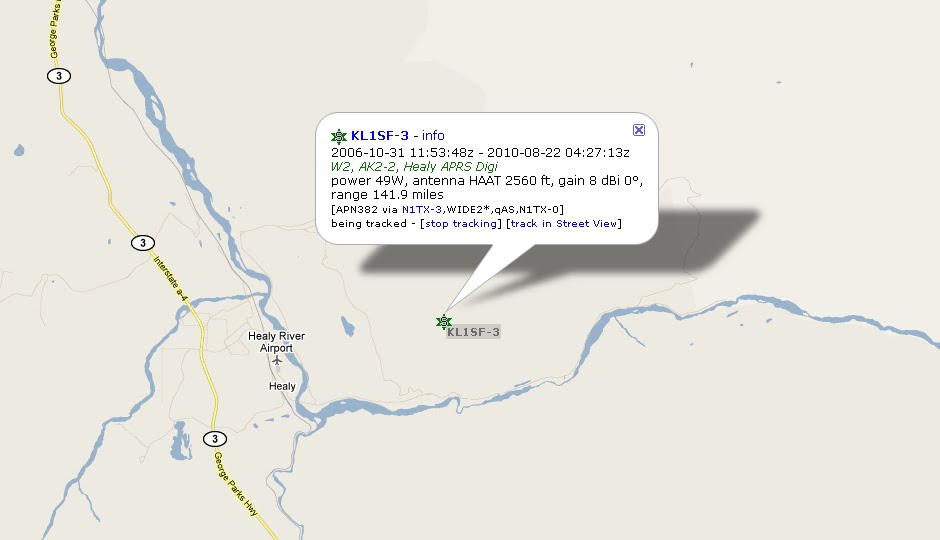
KL1SF-3 and the KL7KC Healy Repeater Fall Silent
There is a popular location for antenna's not far from Healy, located at the Usibelli Repeater Site. This site has a great view of Healy and has line of sight communications into Fairbanks. Topping out in the area of 3800 feet, this wind blasted mountain top has been the home to some ham radio activity, or it was until this weekend.
KL1SF has had an APRS Digi at this location for several years. This has allowed many a visitor running APRS to be heard and relayed into Sean's I-gate as they travel north and south on the George Parks Highway (RT 3). This was also a very reliable link to Fairbanks. APRS has grown very popular as many people had packet equipment from the early days and this was / is a perfect way to keep those TNC's working.
As in life, all good things must come to an end and that is what happened this weekend with KL1SF-3 located on "Antenna Hill" overlooking Healy. Sean and his family are relocating to the Grand Canyon and his equipment is going with him. Sean and I had not been up to check on his equipment for at least two years. We access the area by ATV and depending on the time of year, the ride can be (and normally is) not for the beginning or faint of heart. Our recent dry weather allowed an easy transition up to the repeater site and Saturday, August 21st, 2010 Sean's APRS Digi went silent. Sean unplugged the equipment and took down his Cushcraft 124WB and we carried it down the mountain with us. I know it was a sad day for Sean but you will once again see him active on APRS from Arizona, I'm sure. His packets will be heard once again in the coming weeks.
I was deep into the packet craze many moons ago and I have a TNC on the shelf. I have plans of filling the gap in Sean's absence. It will not have the range or coverage that Sean's digi had (yes, I could use the same location but getting there can be extremely challenging especially in the winter months when I have no way to sled up there) but I'm hoping to fill some of the void. In the coming weeks, I plan on firing up my packet station and putting it to use once again. My KPC-3 has been silent on the shelf and I'm sure it will be glad to be brought back to life. I should have a pretty good path to Nenana so I'm hoping that this will give coverage from Nenana south, possibly south of Denali National Park's main entrance.
Last year Sean and I were asked about removing the KL7KC repeater which was also in the same location as Sean's APRS equipment. This repeater had apparently been having technical issues and it was determined that it should be removed. Possibly as Sean, KL1SF had a two meter repeater that covered Healy for the last few years anyhow. Sean and I had plans of removing the KL7KC repeater last fall but the weather beat us and conditions deteriorated to the point we could not make the trip. After making the trip up to remove Sean's APRS equipment, I wanted to make a trip back up the following day and retrieve the KL7KC repeater as the weather forecast looked promising.
Sean was busy preparing for his move so my wife and I made our way up to Antenna Hill. It did not take me long to unplug the repeater and remove it from it's resting place. We carried it out to my ATV where it was carefully placed into my ATV trailer for the trip back to my QTH. The ride is a bit rough
KL1SF has had an APRS Digi at this location for several years. This has allowed many a visitor running APRS to be heard and relayed into Sean's I-gate as they travel north and south on the George Parks Highway (RT 3). This was also a very reliable link to Fairbanks. APRS has grown very popular as many people had packet equipment from the early days and this was / is a perfect way to keep those TNC's working.
As in life, all good things must come to an end and that is what happened this weekend with KL1SF-3 located on "Antenna Hill" overlooking Healy. Sean and his family are relocating to the Grand Canyon and his equipment is going with him. Sean and I had not been up to check on his equipment for at least two years. We access the area by ATV and depending on the time of year, the ride can be (and normally is) not for the beginning or faint of heart. Our recent dry weather allowed an easy transition up to the repeater site and Saturday, August 21st, 2010 Sean's APRS Digi went silent. Sean unplugged the equipment and took down his Cushcraft 124WB and we carried it down the mountain with us. I know it was a sad day for Sean but you will once again see him active on APRS from Arizona, I'm sure. His packets will be heard once again in the coming weeks.
I was deep into the packet craze many moons ago and I have a TNC on the shelf. I have plans of filling the gap in Sean's absence. It will not have the range or coverage that Sean's digi had (yes, I could use the same location but getting there can be extremely challenging especially in the winter months when I have no way to sled up there) but I'm hoping to fill some of the void. In the coming weeks, I plan on firing up my packet station and putting it to use once again. My KPC-3 has been silent on the shelf and I'm sure it will be glad to be brought back to life. I should have a pretty good path to Nenana so I'm hoping that this will give coverage from Nenana south, possibly south of Denali National Park's main entrance.
Last year Sean and I were asked about removing the KL7KC repeater which was also in the same location as Sean's APRS equipment. This repeater had apparently been having technical issues and it was determined that it should be removed. Possibly as Sean, KL1SF had a two meter repeater that covered Healy for the last few years anyhow. Sean and I had plans of removing the KL7KC repeater last fall but the weather beat us and conditions deteriorated to the point we could not make the trip. After making the trip up to remove Sean's APRS equipment, I wanted to make a trip back up the following day and retrieve the KL7KC repeater as the weather forecast looked promising.
Sean was busy preparing for his move so my wife and I made our way up to Antenna Hill. It did not take me long to unplug the repeater and remove it from it's resting place. We carried it out to my ATV where it was carefully placed into my ATV trailer for the trip back to my QTH. The ride is a bit rough
and an old comforter we had helped make the trip more comfortable for the retired repeater. I was glad it fit but being as large as it was, it was not very light. This made for an interesting decent down the mountain but we safely made it by taking our time and my wife watching from behind for any potential problems. It was only a matter of a few hours after our departure from home that we made it back with the repeater which will be returned to the rightful owner.
So in one weekend, three ham radio related communication stations fall silent. KL1SF's APRS Digi, his 2 meter repeater, and also the KL7KC repeater. This is a small town with very few active hams. I'm not sure many will notice the change but change is inevitable. It's was a sad day for sure, to see a close friend and his family leave. Not only will I NOT see them at work, I won't be seeing their APRS activities here locally any longer. But, I'm looking forward to tracking Sean's progress as he heads down to the lower 48. APRS is a great tool for that very reason. He may no longer live just a few miles away but with ham radio, distance is really not a problem. We will just be communicating with another band, moving from 440 to HF. I am looking forward to the day that Sean gets his station back on the air from his new location. I'm not a big SSB fan but that is about to change (as Sean does not operate CW). Safe travels my friend and enjoy the DX that you have missed out on while living in Alaska. Yes, I'm looking forward to hearing the stories of you working 10 and 6 meters again and possibly 2 and 432! The aurora curtain will no longer keep you from filling your log but don't forget, spin that antenna north from time to time as your long time friend will be looking for our next QSO.
Saturday, July 31, 2010
QSL Bureau
Getting a drop from the ARRL bureau is always a nice surprise. Being active in Alaska, these envelopes can get pretty thick. Like a kid at Christmas, I thumb through all of the cards looking at each which has the personal touch of the owner.
With the advent of electronic QSL'ing, many expected hard copy QSL's to dwindle to a drip. I still receive many hard copy QSL cards so the old fashioned way of QSL'ing is still alive and strong. I order 500 at a time and I normally like to change mine each time I order. I enjoy each and every QSL card I get no matter if it's a photo QSL card or just a stand alone stock card. I normally see a handful that really stand out
I enjoy photography so I now place one of my own pictures on the front of my QSL card. Living in Alaska gives me many opportunities to take lots of photos of wildlife and landscapes and some of those photos (thanks to digital photography) are good enough for displaying on a QSL card that will end up being sent to thousands of hams worldwide. With the large amount of digital photos I have accumulated after living here for over 7 years, it can be a hard decision which to use on my next QSL card. I want to make it worthy of being posted in someone's shack or seen on the wall when a ham's photo appears in a magazine (you are like me and look in the background to see if you can spot your QSL card, right?).
I have each and every QSL card that I have received since getting into ham radio well over 20 years ago. I also have a nice collection of airmail envelopes and stamps from direct QSL'ing. I don't do much direct QSL'ing (I answer all, but I don't send much out myself) as I rely on LOTW confirmations for most of my awards. Someday I will probably have to submit hard copy QSL's to add to my electronic confirmations but until that time, I let the cards flow to me rather then sending hoards out after each and every contest looking for confirmations of new countries or states.
I still get many SWL cards and I make sure to respond to each and every one of those as well. Most of those are received via the bureau. The bureau is a cheap way of sending and receiving QSL cards but it can take several years to receive a card via this route. Recently I got one of my cards returned to me with a stamp on it stating the ham was now a silent key. Some hams chose not to use their bureau but for us here in the US, it's just a matter of keeping envelopes at your incoming bureau. To send them, you can send several hundred cards for cheap which is still a great deal with today's economy.
I scanned these handful of QSL cards that I recently received which were only a few of the probably 150 I got in my envelope. I'm thankful for the volunteers who keep the bureau system alive and well. I do get many direct QSL card requests and as a stamp collector, this can be double fun. Getting a new state or country and then getting a new stamp to add to my collection of many years.
I have many favorites of the cards I have collected over the years and at some point in time, I have plans of putting together an album of these cards. They will represent all of the countries that I have worked over the years and also those cards that stood out above the rest either due to a memorable contact or just a beautiful photo on the front of the QSL card. I can only hope my QSL card is in someone's album or on someone's wall as to me, that is the ultimate culmination of a ham radio contact.
With the advent of electronic QSL'ing, many expected hard copy QSL's to dwindle to a drip. I still receive many hard copy QSL cards so the old fashioned way of QSL'ing is still alive and strong. I order 500 at a time and I normally like to change mine each time I order. I enjoy each and every QSL card I get no matter if it's a photo QSL card or just a stand alone stock card. I normally see a handful that really stand out
and I see who printed them for future reference. Most printers put their information on the cards and it's a great way to advertise your business to other hams. Some of the creativity that goes into these QSL cards is outstanding. And as with anything in the world today, the more colors or additions you put on a QSL card, the more expensive it can get. 
I enjoy photography so I now place one of my own pictures on the front of my QSL card. Living in Alaska gives me many opportunities to take lots of photos of wildlife and landscapes and some of those photos (thanks to digital photography) are good enough for displaying on a QSL card that will end up being sent to thousands of hams worldwide. With the large amount of digital photos I have accumulated after living here for over 7 years, it can be a hard decision which to use on my next QSL card. I want to make it worthy of being posted in someone's shack or seen on the wall when a ham's photo appears in a magazine (you are like me and look in the background to see if you can spot your QSL card, right?).
I have each and every QSL card that I have received since getting into ham radio well over 20 years ago. I also have a nice collection of airmail envelopes and stamps from direct QSL'ing. I don't do much direct QSL'ing (I answer all, but I don't send much out myself) as I rely on LOTW confirmations for most of my awards. Someday I will probably have to submit hard copy QSL's to add to my electronic confirmations but until that time, I let the cards flow to me rather then sending hoards out after each and every contest looking for confirmations of new countries or states.
I still get many SWL cards and I make sure to respond to each and every one of those as well. Most of those are received via the bureau. The bureau is a cheap way of sending and receiving QSL cards but it can take several years to receive a card via this route. Recently I got one of my cards returned to me with a stamp on it stating the ham was now a silent key. Some hams chose not to use their bureau but for us here in the US, it's just a matter of keeping envelopes at your incoming bureau. To send them, you can send several hundred cards for cheap which is still a great deal with today's economy.
I scanned these handful of QSL cards that I recently received which were only a few of the probably 150 I got in my envelope. I'm thankful for the volunteers who keep the bureau system alive and well. I do get many direct QSL card requests and as a stamp collector, this can be double fun. Getting a new state or country and then getting a new stamp to add to my collection of many years.
I have many favorites of the cards I have collected over the years and at some point in time, I have plans of putting together an album of these cards. They will represent all of the countries that I have worked over the years and also those cards that stood out above the rest either due to a memorable contact or just a beautiful photo on the front of the QSL card. I can only hope my QSL card is in someone's album or on someone's wall as to me, that is the ultimate culmination of a ham radio contact.
Wednesday, July 28, 2010
Seward Funshine
Recently we headed to Seward, Alaska to spend a handful of camping days with our close friends, Sean and Mindy (KL1SF & KL1MF). Both will be leaving soon for the Grand Canyon, so we are squeezing in as much time together as possible before their August departure. With the purchase of our very first travel trailer, we put it to good use. It rained for most of the time (typical) but we did have one nice day! That was the day we gave ham radio a spin.
I configured my Buddipole as a vertical for 20 meters and mounted it off of the back of our trailer. Once I got it tuned, we heard a few signals, mostly out of Europe. The band was very poor and I expect it was due to a solar wind effect but since I did not have internet (other than my Blackberry) I did not go checking. Either way, it was fun to hook up and tune around looking for signals. In this photo, Sean, KL1SF was tuning around on 20 meter SSB listening for stations. I had to take the opportunity to snap a quick photo of the event.
We talk about summer but it is fast coming to an end. The fireweed is nearing the top and our days are getting shorter. As our local morning temperatures remind us that winter (maybe fall) is not far away. I have yet to get working on any of my antenna issues here at home and I hope I don't cut myself short. I do that every year but when summer arrives, we Alaskan's have to go play! Our winters are dark, long, and cold. We really don't want to be stuck working at home. I still have a goal of accomplishing some antenna work for the fall contest season but I also have some home improvement projects to get going on as well. We are already picking ripe blueberries and soon we will once again be driving to work in the darkness. Ham radio does not take a backseat to much in my world but when summer roles in, the shades to the shack get pulled and the "closed for the season" sign gets posted. Do you blame me?
I configured my Buddipole as a vertical for 20 meters and mounted it off of the back of our trailer. Once I got it tuned, we heard a few signals, mostly out of Europe. The band was very poor and I expect it was due to a solar wind effect but since I did not have internet (other than my Blackberry) I did not go checking. Either way, it was fun to hook up and tune around looking for signals. In this photo, Sean, KL1SF was tuning around on 20 meter SSB listening for stations. I had to take the opportunity to snap a quick photo of the event.
We talk about summer but it is fast coming to an end. The fireweed is nearing the top and our days are getting shorter. As our local morning temperatures remind us that winter (maybe fall) is not far away. I have yet to get working on any of my antenna issues here at home and I hope I don't cut myself short. I do that every year but when summer arrives, we Alaskan's have to go play! Our winters are dark, long, and cold. We really don't want to be stuck working at home. I still have a goal of accomplishing some antenna work for the fall contest season but I also have some home improvement projects to get going on as well. We are already picking ripe blueberries and soon we will once again be driving to work in the darkness. Ham radio does not take a backseat to much in my world but when summer roles in, the shades to the shack get pulled and the "closed for the season" sign gets posted. Do you blame me?
Monday, July 5, 2010
Just in Case
Lately I have been spending a bit more time in the Alaskan backcountry. AT&T, ACS, or any other cellular phone company have coverage in most populated areas but the rest of this large state goes uncovered (excluding satellite). Being prepared is one thing you must do living here. I believe many of the Alaska reality shows have kinda showed that in one way or another. The key to survival here is knowledge, preparation, and communication. This is where ham radio kicks in for me.
After first moving to Alaska, being so far removed from civilization was a bit intimidating. I don't find the backcountry as intimidating anymore because I respect it. When things go wrong here, it's not a matter of will it happen, it's more a matter of when.
Part of my survival kit is taking along my Icom 703 and portable antennas. It may take up a bit more space but no matter what happens, I will most likely have contact with the rest of the world. It gives me that extra piece of mind knowing that if something did go wrong, I have a means of getting help. And not only for me! I could easily drive up on an incident that required emergency personnel response.
What made me think about this today was the fact that in viewing my station logbook, I have not made a contact in well over a month. Does that mean I have not done anything with ham radio? Nope, it's here and I have been enjoying the summer and spending time outdoors and ham radio has been with me all the time. That's the great thing about this hobby, you can take it with you where ever your travels lead. Think about it. A license that is good for ten years, the many modes and bands that we have, and it's there when YOU want or need it. It's nice having that extra piece of mind when we are many miles from the nearest town or cellular tower.
After first moving to Alaska, being so far removed from civilization was a bit intimidating. I don't find the backcountry as intimidating anymore because I respect it. When things go wrong here, it's not a matter of will it happen, it's more a matter of when.
Part of my survival kit is taking along my Icom 703 and portable antennas. It may take up a bit more space but no matter what happens, I will most likely have contact with the rest of the world. It gives me that extra piece of mind knowing that if something did go wrong, I have a means of getting help. And not only for me! I could easily drive up on an incident that required emergency personnel response.
What made me think about this today was the fact that in viewing my station logbook, I have not made a contact in well over a month. Does that mean I have not done anything with ham radio? Nope, it's here and I have been enjoying the summer and spending time outdoors and ham radio has been with me all the time. That's the great thing about this hobby, you can take it with you where ever your travels lead. Think about it. A license that is good for ten years, the many modes and bands that we have, and it's there when YOU want or need it. It's nice having that extra piece of mind when we are many miles from the nearest town or cellular tower.
Subscribe to:
Posts (Atom)