Monday, February 14, 2011

CQ World Wide WPX RTTY Contest 2011

CQ World Wide WPX RTTY Contest
This past weekend was the annual CQ World Wide WPX RTTY Contest. I had not operated RTTY with any seriousness since last years event when I smoked a trap in my 4 element tri-band antenna by feeding it a little too much power 15 meters.


CQ WW RTTY WPX Contest

Call: KL8DX
Operator(s): KL8DX
Station: KL8DX

Class: SOSB20 HP
QTH: Alaska
Operating Time (hrs): 29.49

Summary:
Band  QSOs
------------
  80:   
  40:   
  20: 1059
  15:   
  10:   
------------
Total: 1059  Prefixes = 537  Total Score = 1,316,187

Club: North Coast Contesters

Full Band as seen by Icom


I had decided to do a single band entry on 20 meters, my strongest band. I decided this since I did an all band effort last year (well, all band for me anyhow). I wanted to change it up a bit for 2011. My low band antennas do not do very well so I wanted to take advantage of my strongest band. I also contemplated a low power entry but decided to run with high to take advantage of as my QSO's as possible. I saw the space weather forecast and we were due to see the effects of another solar wind but that was not likely to hit until after the contest. 

I got a late start on Friday afternoon but that was only by about 40 minutes or so. As with any contest, I prefer to park and call CQ. This is where my Icom shines as I run FSK and filter down to 250 Hz. I can normally find a hole someplace and I prefer to hangout in the nosebleed section. I worked lots of lower 48 stations and also a few Japanese stations before the band closed down on Friday night. I was patiently waiting for Europe to start showing up on the waterfall which is around 9 to 10 PM local time (0600z to 0700z). 
By Friday night, European signals were pretty darn good. It was obviously one way propagation as I was hearing them good but apparently they could not hear me. I found a frequency, called CQ until I exceeded my preferred quota with no responses. I decided then to call it a night and try early in the morning on Saturday. My experience has been that my path to Europe is much better under these conditions around 1200z and later. 

I woke up Saturday morning and immediately started to Search & Pounce on European stations. I was glad to see that they were at least hearing me finally. It's great to work the European stations due to the fact they are 3 point contacts (on upper bands) and almost every QSO was a new multiplier with all the prefixes from the different countries. Strangely though, I could not get a run going for the life of me but I could work almost everyone I could hear. So, I tuned up and down the band working as many stations as possible in Europe and points east. 

I worked Europe until the band faded over the North Pole and I turned my antenna toward the lower 48. Once again, I found a small hole and called CQ and opted to run stations rather then exercise my VFO. Again, I prefer to stay
away from the PSK31 (14.070) and weak signal (14.076)
Run Rates for KL8DX
frequencies. I operate those modes and as with any contest, I try to respect that bandwidth to those modes. This also includes the beacon frequencies. I follow a site on Twitter that announces heard beacons and oddly enough, none were heard during the entire weekend contest. This I'm sure is due to the QRM created on or near that frequency (14.100). During CW contests, you will hear CW in the digital spectrum and it's no different with digital as it heads south into the QRP CW spectrum and lower. Working a major contest (or not) is like shopping on Black Friday! It's gonna be crowded, it's gonna try your patience, and you will find both rude and polite operators. Above is a snapshot of where I ran and the lowest I got in the 20 meter band was 14074 but I did not stay long. This was pointed toward Europe and I parked here to draw a few stations that were S&P'n just above that and were new multipliers. These stations did in fact find me and I moved onward and upward.

By the end of Saturday night I had 700 + QSO's. I re-read the rules on Saturday night (thankfully) and realized that single operators were only allowed 30 hours in this contest. I checked N1MM to see how many hours I operated and found I only had about 10.5 hours left. I saw that signals were sounding pretty good from Russia and Europe late Saturday night so I decided to do the same, wake up and get on the air around 1330z on Sunday morning. 

Sunday morning was a carbon copy of Saturday morning, great propagation abroad and more 3 pointers and multipliers were added as the morning progressed. I only experienced one LID moment and that was when EA5IY decided to call CQ and run stations on the frequency I had been on for short while (14.130). And yes, he knew I was there. 
ON4TO
Also, an interesting moment while doing S&P on 20 meters. I had just worked ON4TO and right behind me, I saw KL5DX call him. I immediately could tell that ON4TO was confused (see screen shot above). I suspect that he figured he "busted" my callsign as I saw him give KL5DX the same serial number he gave me. I also saw the delay when ON4TO realized that serial number that I gave him and what KL5DX gave him were very different. So unless ON4TO figured it out and shows in his log that he sent the same number to both KL5DX and myself, it appears I will have this one struck from my log. I get confused with KL7DX quit frequently but this QSO cost me 3 points and a multiplier not to mention it cost ON4TO the same since I believe I was the only "KL8" active in this contest. 

I had a similar close call experience which made me laugh out loud. I was calling CQ and I had W2YE and W2YC calling me at the same time (I did not realize it until afterward). Both were the same signal strength and I was getting parts of both. So, as I normally do, I asked for the W2 only. Both responded. I asked for the W2Y?? again and both responded. Finally, W2YE was decoded on my screen and after working him, W2YC came booming in. Both are in my log and I had to chuckle at the thought of what the chances were of both calling me at the very same time. 

From my score report at the top, you will see I worked 537 different prefixes, roughly half of my log was unique. At the top of that list was EV85DOSAAF! Not sure I would run a contest with that callsign as it's not user friendly to N1MM anyhow. Not much information on the web about this operation other than the QSL manager. 
ON Air Time for KL8DX


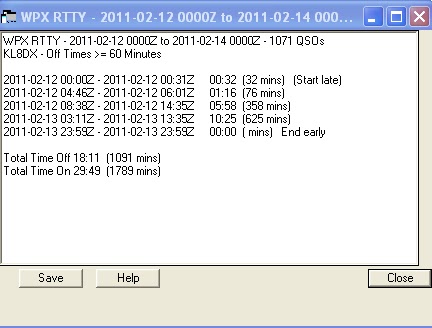
In the end, I could have operated a few more minutes but I did not want to push going over the 30 hour mark. The Aurora and QSB did leave a bit of gibberish on my screen a time or two so I hope I did not bust too many callsigns. I am not sure what was up with the duplicate QSO's but I had more in this contest than any other. I'm not sure if someone caught my callsign in passing and saw it as something other than KL8DX and just immediately called or what. In looking at the cluster after the contest for KL8's, I was spotted as KL8XX, so I assume that could of been part of it but that was at the very end. Most stations probably clicked and called without first verifying my callsign. My strategy when that happens is to ignore them once, call CQ again with my callsign or work another station and if they continue to call, I work work them in hopes they will move on. I won't NOT work dupes as many operators have a macro that states something like "worked before" and they continue to CQ. I can bust a callsign just like the next guy so I don't mind logging them again, respectfully.

I beat my all time record score and number of QSO's in any RTTY contest. The score can start to climb if you work the low bands were those QSO's are worth more points. The propagation was outstanding which allowed for so many QSO's. I'm thankful for all the small stations like mine that get out and play in this contest. From large stacked arrays to the ham who is using an indoor antenna and low power, I'm grateful for each and every contact! Contests can be intimidating but they become addicting. I have read so many threads regarding the use of macros but in the end, I don't care how you have yours set up as long as you call me. I had a few stations send their entire information first before I acknowledged them while others had several line feeds or went on to say 73 and thank me for the contact. Actually, I find these less than common macros a bit challenging or maybe a bit refreshing from the normal every QSO grind. I think it's good to change it up once in awhile but that is my opinion and many operators have heartache over something other than non-perfect, textbook macros. Don, AA5AU has a great RTTY information site that I would highly recommend to any station who is new or wants to start off experiencing this mode. Contests are about accurate, short and sweet exchanges. Remember, it is a contest so it's best just to send what is needed and nothing more, in a format that works.

I have been deeply involved with digital between JT65A and now RTTY. I think it's time I blow the dust off my key and get back to my most favorite of modes. Sadly, I have a very busy schedule over the coming weeks but I hope to be on any chance I get as I need to work on my CW speed for some up coming contests. Our temperatures dropped to -30F this past weekend but I am hoping this is the last deep freeze as the sun is returning and they days are getting longer. I'm looking forward to putting up my Hex beam and also doing some camping with a touch of remote QRP activity, both CW and digital. That's the beauty of this hobby, you can take it with you and it's always willing and ready when you return. To those I worked in the RTTY contest, thanks for calling and sorry to those I missed or could not decode.

Sunday, February 6, 2011

A Bittersweet & Warming Weekend

Sunshine above Mount Healy, Alaska.
Alaskan's look forward to the return of sunshine after doing without it (or seeing very little of it) for the last few months. The sun is now higher than Mount Healy which is just to my south (as seen to the left) and soon we will be able to enjoy the direct sunshine all afternoon. The sun brings hope for longer and warmer days after experiencing a dark and cold winter. Alaskan winters can be pretty harsh but the summers make up for a large part of that. The Midnight Sun is something that I will never get tired of. When the day comes that we depart this great state for our southern retirement ground, I will sure miss it. Some people have problems adjusting to 24 hours of daylight but I welcome it with open arms! I can only hope someday when my wife and I retire that we spend our summers in Alaska and winters someplace a bit more...let's say brighter and warmer.

The sun can bring warmth and enjoyment but as I have mentioned so many times, the sun can produce plenty of silence for the northern exposed ham radio operator. This was this case this past weekend. The effects of a solar wind caused a geomagnetic storm that rendered the ham bands useless for me.
HAARP
HAARP showed lots of absorption and it was obvious after checking the website and listening to the bands, my hopes of operating in the MN QSO Party and a few others were shattered. Only the strongest signals were heard and on a few occasions, the signals would be there one minute and gone the next. Even as I write this, signals are extremely weak and most that I am hearing are from the far left coast.

Aurora as seen from KL8DX & KL8SU's QTH
The bittersweet part to this story is that during the winter we experience these geomagnetic storms. Often times we are treated to an auroral display that can last for hours. As we approach spring, these displays get a bit more pronounced. I was able to spend time outdoors last night capturing a few photos of the green lights of winter overhead. It is frustrating sometimes when you look forward to a weekend of radio activity and a geomagnetic storm puts a damper on your efforts, however it's always great to see the Northern Lights, too. Many have never experienced the Aurora but when the conditions are right, the Aurora can be viewed well into the lower 48 states (I have photographs I took of the Aurora when we lived in Ohio). I'm just thankful we had clear skies this weekend so we could at least enjoy the light show. What's depressing is when there is no radio activity and the clouds overhead keep you from viewing this magnificent wonder.

The sun can make the heavens shine bright even on the darkest nights. As I have written before, the summer midnight sun and the green lights of winter are my most favorite. I'm glad that during these geomagnetic storms the bands head south otherwise, I would miss events like last night. It might be cold outside but the green lights of winter warm the heart and soul. At least for me it does.

Monday, January 31, 2011

SKCC QRP Defeat...again

During the month of January, the SKCC organization has their yearly K3Y Special Event. This year was no exception. They look for volunteer operators from each of the US Districts including Hawaii and Alaska. I normally throw my hat in the ring to operate as my way to support the club. This year was nice as I believe we had a record number of Alaskan operators doing their part to operate K3Y/KL7. With my limited time to operate, I only netted 267 QSO's while operating K3Y/KL7. Life tends to interfere with ham radio on a regular basis. It does for you too, right?

This year my goal was to try a "Sweep" working all ten US Districts along with Alaska and Hawaii, with 5 watts or less. I made it operating high power rather easily but I got a late start operating QRP, as I devoted more time to being chased than chasing. When the dust cleared today, I came up short yet again. I managed to work all but K3Y/1, K3Y/5, K3Y/9, and K3Y/KH6 while operating on 5 watts or less. So I missed my sweep by a few. Sadly, my attempts to snag the last two failed on the very last day of operation. The band was there, I could hear the stations operating their respective K3Y districts, but they could not hear me (I was hearing them on an average of S5). If I was hearing them S5 and they were running 100 watts (or more) and they could not hear me well, you do the math. If you double your power, how many S units do you gain?  Exactly! 

QRP can be very frustrating at times and there are those that probably think that QRP operating from up here is...well...just insane. If you have not operated from Alaska (or near the Arctic Circle in EU, Canada, etc), you probably don't know what I'm talking about. I've mentioned it before that 100 watts is challenging so trying to do it with 5 watts is nearly extreme. But, with the right propagation, the right receiving station, this can be done. I feel operating QRP, the receiving station takes most of the burden when it comes to logging a QRP QSO. QRP to QRP however, it's a shared effort. The QRP station needs to know how to predict the right times to operate but in the end, it's the receiving station that often times has to pre-amp and filter up to pull that QRP signal out of the static. Then add in QRN, QSB, QRM...well, you get the picture.This has been debated by many but that's my opinion being on both the receiving and sending side of QRP activities.

It takes a patient soul to be able to operate QRP and often times, just as patient of a receiving operator. But, when conditions are just right, a long distance QRP QSO can be the ultimate rush. Now obviously there are things you can do to make these QSO's easier, such as larger antenna's or simple elevation. When I operated with Steve, wG0AT from atop Mt. Herman, it opened my eyes to what 9,000 feet of elevation can do to reception and how far a QRP signal can travel. Sure beats my 1,800 feet!

In the end, QRP is lots of fun and I'm looking forward to doing much more with CW and digital. I am envious of the lower 48 stations who operate QRP as I will watch the QRP Spots Page seeing them spot and work stations when I can't hear a one. But, location has plenty to do with it as well. Just look at what the guys in the Caribbean can work! They not only have some of the best propagation, but they have the great weather and beaches to go along with it. Of course, it must be hard to stay in the shack in such a tropical paradise but it's rather easy to stay in the shack in Alaska during the winter months.  Then again, playing radio while sitting on the beach with a warm ocean breeze sounds like paradise to me! And speaking of wG0AT, he and the Buddipole team are once again doing that very thing as they should be enjoying the warmth of Dominica as I write this. Hope to log a few of the gang...

Sunday, January 30, 2011

Weekend Weak Signal

I spent a large part of the weekend focusing on JT65A yet again. This mode is extremely fascinating to me due to the weak signal decode ability that it has.  I also did a bit of PSK31 looking for that last state I need for LOTW WAS, Maine. Came up short yet again with Maine but I know someone willing to send Maine my way on PSK31. He has offered, I just need to set up a sked. I was hoping to get it by chance, but I think with another high speed solar wind due to strike again in the next week, I had just better take advantage of the offer.

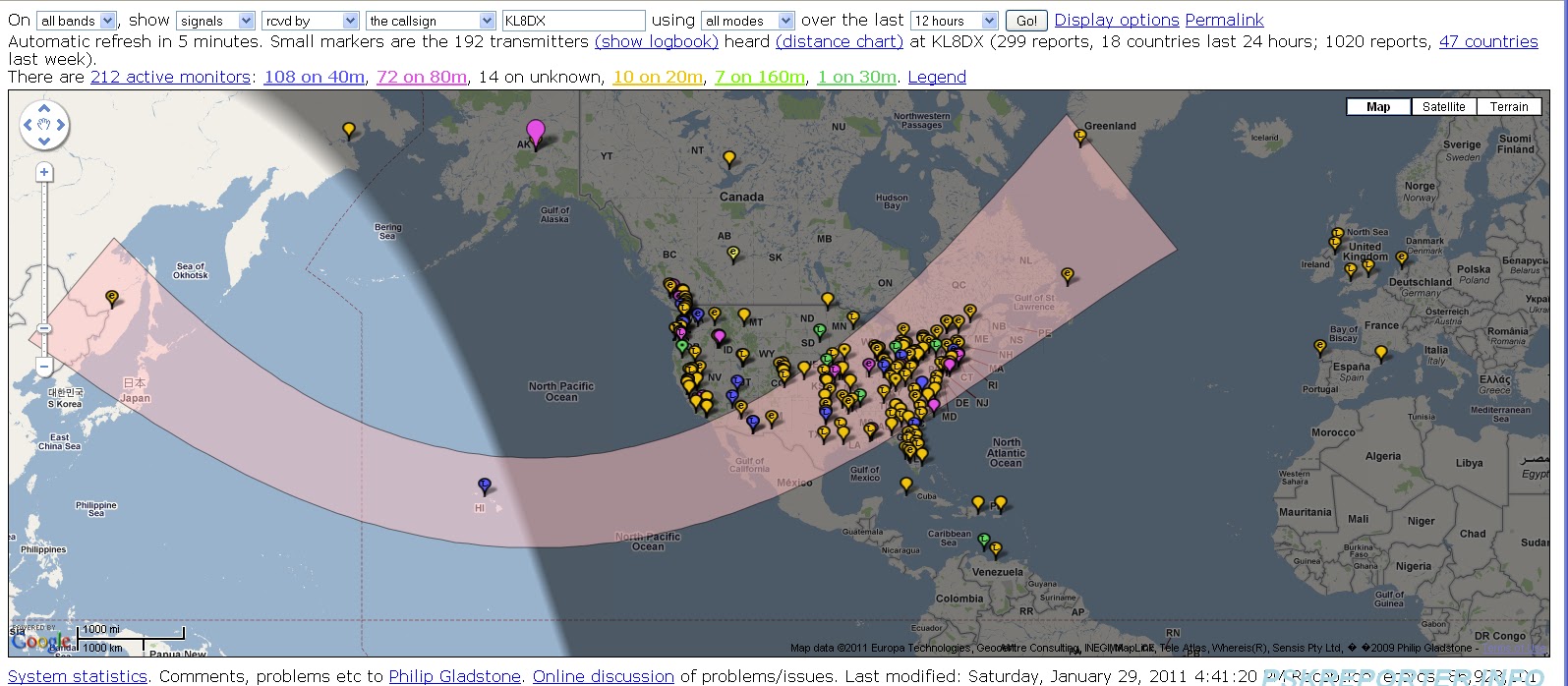
The map above from PSK Reporter shows some of areas I had propagation to over the last 12 hours. You will see some European stations on this map from earlier this morning. I had become frustrated with PSK31 as a digital mode to contact European stations as the software and mode does not do well with polar flutter. JT65A is much better with this but even it has limits with polar flutter. I found this to be the case this morning as I attempted to decode a few stations on the other side of the North Pole.

You can see I had several moderately strong stations in the waterfall but I often times would go one to two minutes between a decode (screen shot to the right). PSK31 would not have decoded a trace but at least JT65A does better with this condition. Again, with the echo and flutter, it does have some limitations but at least I can work stations under this condition. I messed around with the audio input settings (a bit high as seen here) but even the signals show a much wider trace than normal. I believe this is a visual indicator of the flutter and echo I was hearing. Either way, this software / mode does extremely well and I have tested it on my strong and weak bands. It has allowed me to work parts of the lower 48 or other countries I did not think I had the ability to work due to my station limitations. It's awesome to be able to have a valid contact with a station that is as weak as -24dB! Not possible you say? Just give it a try and you will see..

Here is a perfect example of the ability of JT65A (using JT65-HF software). I do not have a 160 meter antenna but my Hustler ground mounted 5BTV will actually tune this band. While typing this blog entry, you will see I decoded W3ZUP in FM19. He resides in Maryland, which is over 3,200 miles away from my QTH. The software decoded him with a very weak -25dB signal using my vertical! Now, how impressive is that? Not only did it decode him once, but it decoded him a second time at that signal strength!

~~~~~~~~   ¥¥¥¥¥  ~~~~~~~~~

I guess since I have written about this mode a few times, you can sense my excitement about it. But I'm sure others also feel as I do. This gives us small stations a way to work states and countries we never expected to work. Heck, I have worked farther on 80 meters than I have ever worked before. I did not think that WAS (Worked All States) was a possibility on 80 meters for me but with this mode, there is hope! The JT65A crowd is growing daily so the more stations that are on, the better my chances to accomplish my award goals. Plus, there is something about calling CQ and seeing someone coming back to your call and the anticipation as you wait to see who it is, approximately 50 seconds later.

Monday, January 17, 2011

Digital QRP - Check!

I have been on a quest since the purchase of my used Icom IC-703Plus and my recent purchase of a Dell Mini 10", to get it working on the digital modes. I not only enjoy CW QRP when we are out camping but I wanted to go the next step and start doing some PSK31, JT65A, Olivia...you know, the main modes good for weak signal. I also want to give Feld Hell a run QRP, too. I had a spare Rigblaster Plus which I keep on the shelf in case one of my other two fail. In doing a bit of research, I stumbled across an all inclusive interface cable which would give me rig control and get me talking with HRD, MMTTY, N1MM, and JT65-HF. It was while doing a search on eBay where I eventually purchased the needed cable. I then went to the sellers website where I found the support documentation I needed to get things plug into the right places. You can learn more about the cable I purchased at; 


It took me longer to download HRD (Ham Radio Deluxe) than it did to get my radio transmitting PSK-31 with my Mini Dell. Like a kid in a candy store who can't wait, I called CQ on PSK31 and K7MSC came right back to me! My first digital QRP portable station QSO! I chatted with Mitch for a few minutes, or at least until a station moved in on top of us and ended our QSO. Mitch gave me the information that I was looking for in regards to my signal, S/N and IMD along with a signal report. I was pretty darn happy!  It was time to move onto JT65!

I fired up JT65-HF and I noticed that the software was not fitting my screen properly. I was missing the bottom half of the program. When I attempted to push or move it up, my Dell Mini refused to let that happen. I could move it to either side and down, just not up. I checked the JT65-HF reflector for similar posts and found a conversation involving Allan, ZS1LS. I saw Allan was also using a Dell Mini so I sent off a quick e-mail asking how I could resolve my problem. Allan explained that there was a separate .exe with a smaller GUI.

Sure enough, when I went looking, there was that magic sg-jt65-hf.exe file! Once I changed out shortcuts to the proper .exe file, I was in business! Well, almost...

I found JT65A signals on 20 meters but I was not decoding anything. It's extremely important and almost a criminal act if your PC clock is off by a few seconds. Well, I was not decoding because my Dell Mini was off by more than 5 seconds, ouch! I downloaded and installed Dimension 4 v5.0. I run on most all of my computers Atomic Clock Sync but it did not sync often enough.  The Dell Mini clock is horrible at keeping accurate time so it needs a nudge almost every minute or two. After I got my clock back in sync, magically callsigns and reports started to appear on my computer screen. I was in business!  Or so I thought...

I had HRD running along with my logbook and when I went to set up my JT65-HF software, I had it grab the QRG (Frequency) from HRD. These programs are easily married and live wonderfully together! When I went to send my first transmission, nothing! I tried to configure it for different serial ports but nada!  So, in troubleshooting the problem, I closed out HRD and the logbook and when I went to transmit using JT65-HF (using Com3) it worked like a charm! So, it's obvious that I need to resolve a conflict There are four USB ports on the computer so I may have maxed out my com ports on this little computer. Won't know until I dive in a bit deeper. I need to check with the group (or with Allan again) to see if anyone else is using a similar setup and having success. But for now, I can transmit on the modes I was looking for and I just need to add and tweak some macros! I tried all available (or unavailable) com ports in the JT65-HF software with no luck!

In conclusion, the interface cable will be much easier to tote along than an interface such as my Rigblaster Plus. The Dell Mini can give me an easy 8 hours of operation between charges and it's very small. A perfect fit for a backpack and my QRP equipment! I now just need to wait for the return of the midnight sun so we can go camping and I can spend some time on the Denali Highway, enjoying some quiet radio time. But, with the Polar Bear club activities, I hope to be out this winter yet. 27 below zero yesterday, a high today of 3 above, the weather is worse than the propagation around here at times not knowing what it wants to do! I'll keep ya posted. Oh, FSK RTTY is also something I want to get configured. If it were summer, these troubleshooting projects would be on the shelf!

72 de KL8DX/QRP

Sunday, January 16, 2011

Propagation Study Continues

PSK Reporter
I have really been enjoying JT65A on the low bands. I have used WSPR as well but the advantage of this mode (JT65) is that you can make contacts with other stations and these contacts count for awards. For the last several days, I have been leaving JT65-HF up on various bands to see what type or propagation I have and when. As the days start to slowly get longer, the bands will slowly change as well. 

Saturday night, I left the software running on 20 meters and I noticed that European stations started making a steady appearance around 1300z (yea, I'm in a deep sleep about then). The peak of the EU propagation seemed to be around 1500z to 1600z. It started to drop before it finally fell out around 1700z. In the map above you will see many of the stations I heard directly at my location. Many of these stations were running some pretty low power. Living in a propagationally challenged part of the world, I have decided that I am going to attempt to find the best path at the best time. Now mind you, a larger station will be hearing more earlier and hearing later but this test is specific to my station so I would consider it personalized. I have mentioned propagation in my blog many times before but if I want to make contacts and complete skeds with other stations, I need to understand the best time to be successful. It is also useful information for contests especially to determine when the best time to find open propagation to certain parts of the world are. I am most intrigued with my polar path into Europe.


I am not even going to begin to admit that I know the first thing about propagation because I don't. I just need to find out what works for me and the limits of my small station. With JT65A (and other programs like WSPR, etc) you receive a report from the station you're working (or that's hearing you due to many stations uploading reception reports to a dedicated website) on how well your signal is being heard. This is what I find extremely interesting. It has helped me realize that with my low band antenna's, I am sure hearing much better than I'm being heard. Now I need to understand why and attempt to make this a more even playing field by making external adjustments or changes. Of course, we are all at the mercy of space weather and more, in regards to propagation anyhow. It's not uncommon to have the band fold here in a matter of minutes due to absorption (as seen in the HAARP chart above). This chart was from the last 36 hours of this posting and you can see some of the challenges.  We have a saying, "Red is Dead".

Having access to this great information from various websites like HamSpots, PSK Reporter, or simple screen shots from stations on the other end of the QSO, can sure help shed some light on the abilities of my station. The screen shot to the left was from my friend Andy, VE9DX in New Brunswick, Canada. This was how well Andy was hearing me and after obtaining Andy's station information, it helped me understand a bit more about my path to the east. It seems my antenna radiates better directly east or just north of east favoring northern USA and Canadian stations and of course Europe. This can be changed with a simple rearranging of my antenna configuration or by using more than one antenna. I am also surrounded by mountains so again, testing my paths will help me determine the best antenna configuration to use. My best propagation is from approximately 80 degrees to 240 degrees. Beyond that, those remaining locations on the globe can be pretty challenging for me (on 20 meters anyhow, my strongest band). Now that I'm getting into QRP operating, this is extremely valuable information.

Having a small station, you must take advantage of every useful tool available if you want to be successful. I have worked many stations on the other side of the US that were only running indoor antennas with no more than 100 watts. You don't need 200 foot towers and large antenna's to make long distance contacts. How often do we look at the weather forecast and make plans because the weather is going to be nice, or even cancel plans because the weather is going to be crappy. The same applies to ham radio and propagation. Take advantage of all these great resources and you will find it's like a good book, hard to put down after you get started. I have opened the book of propagation and I have only read the first sentence. So much more to read, so much more to learn...

Monday, January 10, 2011

Buffet of Ham Radio Fun with a Sad Ending


This past weekend had a bit of everything for the contesting type. I wanted to operate in four different contests, the NAQP CW, the PODXS 070 PSKfest, SKCC WES, and the ARRL RTTY Roundup. And to top it all off, I was going to operate as K3Y/KL7 in the SKCC Weekend Sprint. So, with all that going on, I could not just focus my efforts on one contest but had to spread my operating across a few modes as a few of the contest times overlapped. My operating began in the NAQP CW contest. It was apparent that the bands were very poor due to the effects of a high speed solar wind. Running 100 watts from Alaska during this type of geomagnetic activity is like running QRP using 1 watt to a coat hanger. After a few attempts at trying to get a run going, I gave in and flipped the power switch to my AL-1500. I knew it was going to be a rough weekend! And yes, if I do submit my log, it will be a checklog due to using high power (NAQP is only a low power contest).

After parking and calling CQ and nearly wearing out my F1 button on my keyboard (CQ NA), when all was said in done I flew the white flag at 2240z. I operated three hours and only made 126 QSO's and worked 33 multipliers. Yea that's rough but I understand that contesting is not always easy. I'm not saying I gave up, just moved onto the next contest is all.

I made my first PSK31 contact at 2305z as it took me a bit to get the station set up to run digital. I worked the contest until the end, my last QSO being at 2359z. When the dust cleared in just under an hour, I worked 27 contacts on PSK31, with one being a dupe. It seems I was having better luck on PSK31 than I was on CW! 

As far as the RTTY Roundup, I only made a handful of contacts between 0110z on the 9th and 0135z. I made a whopping 11 contacts on RTTY before deciding to move on. I had not operated RTTY in ages so it was good to get my feet wet again. I do plan a low power run in one of the up coming major contests. 

Sunday was dedicated to operating K3Y/KL7 for the SKCC club. I operated for 6 hours on Sunday making 63 contacts. Again, very poor band conditions lead to a slow rate. Obviously working manual CW my rate is going to be substantially lower. I'm am not very good with high speed CW so my average rate during a contest is only around 130 an hour on a very good day. I described myself as a DX'er and a greenhorn contester. I won't be breaking any records or hanging any plaques on my shack wall. I'm in it for fun and have been lucky enough to score a bit of wallpaper for my efforts. 

My Monday operation for K3Y/KL7 was from 1900z thru 2359z. The band (20 meters) was a bit better today but still not very good. I was experiencing lots of QSB and it was obvious I was being heard much better than I was hearing. Still with that said, I was able to struggle and make 45 CW contacts. 

QRP operating is a bit different and it can be really tough at times to pull those stations out. I am getting into QRP myself so I am beginning to understand the challenges with running lower power however, I think operating from here with QRP levels multiplies the difficulty by 10. Granted, when the band is wide open, it's open. But on an average day, life is tough here with 100 watts. Just ask any Alaskan station that has operated low power in the NAQP contests. I bet they all tell you the same!  But, I enjoy helping other hams complete their quest for a new state, DXCC country, or county award. But when I get comments like;

"Phil, thanks for being there for us during this month of K3Y.  What fun it is.
Once I got the sweep, I've now moved to do it again, QRP (4W)  It's all about
band condx's and good op's like you.   thank YOU!"


It makes it all worth while. I had a few more positive comments on the SKCC Sked Page.   So even though it was a struggle, it was well worth the effort to not only support a great mode, but also support a great club and doing what ham's do best, helping others! Oh and I did have fun, too.

In reference to my sad note, I had worked several stations in the NAQP using the name "Tom". Little did I know, until I started to read the 3830 posts, that it was for WX4TM! I was floored when I read that! I had not heard the news that Tom became a Silent Key. Tom was always extremely kind and we talked about Alaska through email and on radio, even stopping during contests for a brief chat. Had I known, I would of been using Tom as well in my exchange. Tom, you will be missed and there will from now on be a void in my logbook. Thanks for all the QSO's!!!

Monday, January 3, 2011

Hello 2011, can I go back to 2010? And hanging my KMPW Wallpaper!

In a previous post I mentioned one of my first QRP awards and that was ARCI's KMPW award. I'm proudly displaying that award on my shack wall. I am becoming more active in QRP and it's sure a challenge running low power, especially from here in Alaska. I ordered a cable that will allow full rig control and FSK so I'm looking forward to possibly doing a bit of contesting QRP as well. Stay tuned for that one!

2011 started off a bit rough. I worked my first stint as K3Y/KL7 which went very well. I made 60 contacts in 3 hours, which is not a lot but when you are manually making the CW contacts, it's not too bad! After the contest, I was spending a bit of family time in our living room and I noticed one of the guys to my tower appearing to have excess slack. We were receiving the effects of a winter Chinook which blows in from the SE and brings warm air up from the Gulf of Alaska. Now mind you, I live in a windy area anyhow but my highest gust received was 62 mph this past weekend. Sometime during this wind storm, the bracket securing my main tower to the house literally sheered in half! After realizing what had happened, I asked my wife for her assistance and we made a mad dash outdoors to get the tower secured as best we could in the high winds.

My first order of business was dropping my beam down to roof level. Once that was accomplished, we secured the tower by adjusting guy wires and also adding a few lower guys. Thankfully, the tower stayed vertical and once the winds dropped down to 30 mph and less, I ventured out to see what I could do to get things back in operation.

I started to dig out the tower base which was under several feet of snow. I have a tilt base Rohn 25 and I had discovered that with the securing bracket broken, the rocking motion of the tower due to the wind loosened two of the three bolts securing the tower to the buried tilt section. I secured the bolts and afterward I was able to get the HF beam back to the 43 foot level. We readjusted and secured the guy wires but I also found that my 80 meter inverted V was damaged. One of the legs snapped at the balun. I was able to fix that from the roof and after some rearranging of wires, the 80 meter wire was back in service.

The bracket securing the tower to the house will have to wait until spring. I will be paying very close attention to weather forecasts for the rest of the winter. It's not uncommon to get wind of 50 to 55 mph here, we are used to that. Anything less than 50 mph is considered a breeze in these parts. It's the winds that exceed 60 mph that get my attention. Having a Hazer system on a tower makes it much tougher to guy and secure as you need for the Hazer to be able to track up and down the tower. Even though 2011 came in rough, I'm hoping it means that things can only get better from here. Now I'm looking forward to next weekend with some major contests on the horizon. My excitement might be short lived as I see we are about to receive the effects of a coronal hole throwing a high solar wind in earths direction. If that's the case, we might have some good auroral photographing opportunities as the bands will probably be very quiet.