Monday, January 17, 2011

Digital QRP - Check!

I have been on a quest since the purchase of my used Icom IC-703Plus and my recent purchase of a Dell Mini 10", to get it working on the digital modes. I not only enjoy CW QRP when we are out camping but I wanted to go the next step and start doing some PSK31, JT65A, Olivia...you know, the main modes good for weak signal. I also want to give Feld Hell a run QRP, too. I had a spare Rigblaster Plus which I keep on the shelf in case one of my other two fail. In doing a bit of research, I stumbled across an all inclusive interface cable which would give me rig control and get me talking with HRD, MMTTY, N1MM, and JT65-HF. It was while doing a search on eBay where I eventually purchased the needed cable. I then went to the sellers website where I found the support documentation I needed to get things plug into the right places. You can learn more about the cable I purchased at; 


It took me longer to download HRD (Ham Radio Deluxe) than it did to get my radio transmitting PSK-31 with my Mini Dell. Like a kid in a candy store who can't wait, I called CQ on PSK31 and K7MSC came right back to me! My first digital QRP portable station QSO! I chatted with Mitch for a few minutes, or at least until a station moved in on top of us and ended our QSO. Mitch gave me the information that I was looking for in regards to my signal, S/N and IMD along with a signal report. I was pretty darn happy!  It was time to move onto JT65!

I fired up JT65-HF and I noticed that the software was not fitting my screen properly. I was missing the bottom half of the program. When I attempted to push or move it up, my Dell Mini refused to let that happen. I could move it to either side and down, just not up. I checked the JT65-HF reflector for similar posts and found a conversation involving Allan, ZS1LS. I saw Allan was also using a Dell Mini so I sent off a quick e-mail asking how I could resolve my problem. Allan explained that there was a separate .exe with a smaller GUI.

Sure enough, when I went looking, there was that magic sg-jt65-hf.exe file! Once I changed out shortcuts to the proper .exe file, I was in business! Well, almost...

I found JT65A signals on 20 meters but I was not decoding anything. It's extremely important and almost a criminal act if your PC clock is off by a few seconds. Well, I was not decoding because my Dell Mini was off by more than 5 seconds, ouch! I downloaded and installed Dimension 4 v5.0. I run on most all of my computers Atomic Clock Sync but it did not sync often enough.  The Dell Mini clock is horrible at keeping accurate time so it needs a nudge almost every minute or two. After I got my clock back in sync, magically callsigns and reports started to appear on my computer screen. I was in business!  Or so I thought...

I had HRD running along with my logbook and when I went to set up my JT65-HF software, I had it grab the QRG (Frequency) from HRD. These programs are easily married and live wonderfully together! When I went to send my first transmission, nothing! I tried to configure it for different serial ports but nada!  So, in troubleshooting the problem, I closed out HRD and the logbook and when I went to transmit using JT65-HF (using Com3) it worked like a charm! So, it's obvious that I need to resolve a conflict There are four USB ports on the computer so I may have maxed out my com ports on this little computer. Won't know until I dive in a bit deeper. I need to check with the group (or with Allan again) to see if anyone else is using a similar setup and having success. But for now, I can transmit on the modes I was looking for and I just need to add and tweak some macros! I tried all available (or unavailable) com ports in the JT65-HF software with no luck!

In conclusion, the interface cable will be much easier to tote along than an interface such as my Rigblaster Plus. The Dell Mini can give me an easy 8 hours of operation between charges and it's very small. A perfect fit for a backpack and my QRP equipment! I now just need to wait for the return of the midnight sun so we can go camping and I can spend some time on the Denali Highway, enjoying some quiet radio time. But, with the Polar Bear club activities, I hope to be out this winter yet. 27 below zero yesterday, a high today of 3 above, the weather is worse than the propagation around here at times not knowing what it wants to do! I'll keep ya posted. Oh, FSK RTTY is also something I want to get configured. If it were summer, these troubleshooting projects would be on the shelf!

72 de KL8DX/QRP

Sunday, January 16, 2011

Propagation Study Continues

PSK Reporter
I have really been enjoying JT65A on the low bands. I have used WSPR as well but the advantage of this mode (JT65) is that you can make contacts with other stations and these contacts count for awards. For the last several days, I have been leaving JT65-HF up on various bands to see what type or propagation I have and when. As the days start to slowly get longer, the bands will slowly change as well. 

Saturday night, I left the software running on 20 meters and I noticed that European stations started making a steady appearance around 1300z (yea, I'm in a deep sleep about then). The peak of the EU propagation seemed to be around 1500z to 1600z. It started to drop before it finally fell out around 1700z. In the map above you will see many of the stations I heard directly at my location. Many of these stations were running some pretty low power. Living in a propagationally challenged part of the world, I have decided that I am going to attempt to find the best path at the best time. Now mind you, a larger station will be hearing more earlier and hearing later but this test is specific to my station so I would consider it personalized. I have mentioned propagation in my blog many times before but if I want to make contacts and complete skeds with other stations, I need to understand the best time to be successful. It is also useful information for contests especially to determine when the best time to find open propagation to certain parts of the world are. I am most intrigued with my polar path into Europe.


I am not even going to begin to admit that I know the first thing about propagation because I don't. I just need to find out what works for me and the limits of my small station. With JT65A (and other programs like WSPR, etc) you receive a report from the station you're working (or that's hearing you due to many stations uploading reception reports to a dedicated website) on how well your signal is being heard. This is what I find extremely interesting. It has helped me realize that with my low band antenna's, I am sure hearing much better than I'm being heard. Now I need to understand why and attempt to make this a more even playing field by making external adjustments or changes. Of course, we are all at the mercy of space weather and more, in regards to propagation anyhow. It's not uncommon to have the band fold here in a matter of minutes due to absorption (as seen in the HAARP chart above). This chart was from the last 36 hours of this posting and you can see some of the challenges.  We have a saying, "Red is Dead".

Having access to this great information from various websites like HamSpots, PSK Reporter, or simple screen shots from stations on the other end of the QSO, can sure help shed some light on the abilities of my station. The screen shot to the left was from my friend Andy, VE9DX in New Brunswick, Canada. This was how well Andy was hearing me and after obtaining Andy's station information, it helped me understand a bit more about my path to the east. It seems my antenna radiates better directly east or just north of east favoring northern USA and Canadian stations and of course Europe. This can be changed with a simple rearranging of my antenna configuration or by using more than one antenna. I am also surrounded by mountains so again, testing my paths will help me determine the best antenna configuration to use. My best propagation is from approximately 80 degrees to 240 degrees. Beyond that, those remaining locations on the globe can be pretty challenging for me (on 20 meters anyhow, my strongest band). Now that I'm getting into QRP operating, this is extremely valuable information.

Having a small station, you must take advantage of every useful tool available if you want to be successful. I have worked many stations on the other side of the US that were only running indoor antennas with no more than 100 watts. You don't need 200 foot towers and large antenna's to make long distance contacts. How often do we look at the weather forecast and make plans because the weather is going to be nice, or even cancel plans because the weather is going to be crappy. The same applies to ham radio and propagation. Take advantage of all these great resources and you will find it's like a good book, hard to put down after you get started. I have opened the book of propagation and I have only read the first sentence. So much more to read, so much more to learn...

Monday, January 10, 2011

Buffet of Ham Radio Fun with a Sad Ending


This past weekend had a bit of everything for the contesting type. I wanted to operate in four different contests, the NAQP CW, the PODXS 070 PSKfest, SKCC WES, and the ARRL RTTY Roundup. And to top it all off, I was going to operate as K3Y/KL7 in the SKCC Weekend Sprint. So, with all that going on, I could not just focus my efforts on one contest but had to spread my operating across a few modes as a few of the contest times overlapped. My operating began in the NAQP CW contest. It was apparent that the bands were very poor due to the effects of a high speed solar wind. Running 100 watts from Alaska during this type of geomagnetic activity is like running QRP using 1 watt to a coat hanger. After a few attempts at trying to get a run going, I gave in and flipped the power switch to my AL-1500. I knew it was going to be a rough weekend! And yes, if I do submit my log, it will be a checklog due to using high power (NAQP is only a low power contest).

After parking and calling CQ and nearly wearing out my F1 button on my keyboard (CQ NA), when all was said in done I flew the white flag at 2240z. I operated three hours and only made 126 QSO's and worked 33 multipliers. Yea that's rough but I understand that contesting is not always easy. I'm not saying I gave up, just moved onto the next contest is all.

I made my first PSK31 contact at 2305z as it took me a bit to get the station set up to run digital. I worked the contest until the end, my last QSO being at 2359z. When the dust cleared in just under an hour, I worked 27 contacts on PSK31, with one being a dupe. It seems I was having better luck on PSK31 than I was on CW! 

As far as the RTTY Roundup, I only made a handful of contacts between 0110z on the 9th and 0135z. I made a whopping 11 contacts on RTTY before deciding to move on. I had not operated RTTY in ages so it was good to get my feet wet again. I do plan a low power run in one of the up coming major contests. 

Sunday was dedicated to operating K3Y/KL7 for the SKCC club. I operated for 6 hours on Sunday making 63 contacts. Again, very poor band conditions lead to a slow rate. Obviously working manual CW my rate is going to be substantially lower. I'm am not very good with high speed CW so my average rate during a contest is only around 130 an hour on a very good day. I described myself as a DX'er and a greenhorn contester. I won't be breaking any records or hanging any plaques on my shack wall. I'm in it for fun and have been lucky enough to score a bit of wallpaper for my efforts. 

My Monday operation for K3Y/KL7 was from 1900z thru 2359z. The band (20 meters) was a bit better today but still not very good. I was experiencing lots of QSB and it was obvious I was being heard much better than I was hearing. Still with that said, I was able to struggle and make 45 CW contacts. 

QRP operating is a bit different and it can be really tough at times to pull those stations out. I am getting into QRP myself so I am beginning to understand the challenges with running lower power however, I think operating from here with QRP levels multiplies the difficulty by 10. Granted, when the band is wide open, it's open. But on an average day, life is tough here with 100 watts. Just ask any Alaskan station that has operated low power in the NAQP contests. I bet they all tell you the same!  But, I enjoy helping other hams complete their quest for a new state, DXCC country, or county award. But when I get comments like;

"Phil, thanks for being there for us during this month of K3Y.  What fun it is.
Once I got the sweep, I've now moved to do it again, QRP (4W)  It's all about
band condx's and good op's like you.   thank YOU!"


It makes it all worth while. I had a few more positive comments on the SKCC Sked Page.   So even though it was a struggle, it was well worth the effort to not only support a great mode, but also support a great club and doing what ham's do best, helping others! Oh and I did have fun, too.

In reference to my sad note, I had worked several stations in the NAQP using the name "Tom". Little did I know, until I started to read the 3830 posts, that it was for WX4TM! I was floored when I read that! I had not heard the news that Tom became a Silent Key. Tom was always extremely kind and we talked about Alaska through email and on radio, even stopping during contests for a brief chat. Had I known, I would of been using Tom as well in my exchange. Tom, you will be missed and there will from now on be a void in my logbook. Thanks for all the QSO's!!!

Monday, January 3, 2011

Hello 2011, can I go back to 2010? And hanging my KMPW Wallpaper!

In a previous post I mentioned one of my first QRP awards and that was ARCI's KMPW award. I'm proudly displaying that award on my shack wall. I am becoming more active in QRP and it's sure a challenge running low power, especially from here in Alaska. I ordered a cable that will allow full rig control and FSK so I'm looking forward to possibly doing a bit of contesting QRP as well. Stay tuned for that one!

2011 started off a bit rough. I worked my first stint as K3Y/KL7 which went very well. I made 60 contacts in 3 hours, which is not a lot but when you are manually making the CW contacts, it's not too bad! After the contest, I was spending a bit of family time in our living room and I noticed one of the guys to my tower appearing to have excess slack. We were receiving the effects of a winter Chinook which blows in from the SE and brings warm air up from the Gulf of Alaska. Now mind you, I live in a windy area anyhow but my highest gust received was 62 mph this past weekend. Sometime during this wind storm, the bracket securing my main tower to the house literally sheered in half! After realizing what had happened, I asked my wife for her assistance and we made a mad dash outdoors to get the tower secured as best we could in the high winds.

My first order of business was dropping my beam down to roof level. Once that was accomplished, we secured the tower by adjusting guy wires and also adding a few lower guys. Thankfully, the tower stayed vertical and once the winds dropped down to 30 mph and less, I ventured out to see what I could do to get things back in operation.

I started to dig out the tower base which was under several feet of snow. I have a tilt base Rohn 25 and I had discovered that with the securing bracket broken, the rocking motion of the tower due to the wind loosened two of the three bolts securing the tower to the buried tilt section. I secured the bolts and afterward I was able to get the HF beam back to the 43 foot level. We readjusted and secured the guy wires but I also found that my 80 meter inverted V was damaged. One of the legs snapped at the balun. I was able to fix that from the roof and after some rearranging of wires, the 80 meter wire was back in service.

The bracket securing the tower to the house will have to wait until spring. I will be paying very close attention to weather forecasts for the rest of the winter. It's not uncommon to get wind of 50 to 55 mph here, we are used to that. Anything less than 50 mph is considered a breeze in these parts. It's the winds that exceed 60 mph that get my attention. Having a Hazer system on a tower makes it much tougher to guy and secure as you need for the Hazer to be able to track up and down the tower. Even though 2011 came in rough, I'm hoping it means that things can only get better from here. Now I'm looking forward to next weekend with some major contests on the horizon. My excitement might be short lived as I see we are about to receive the effects of a coronal hole throwing a high solar wind in earths direction. If that's the case, we might have some good auroral photographing opportunities as the bands will probably be very quiet. 

Friday, December 31, 2010

Look'n in the Rearview at ARS KL8DX

Hard to believe another year has passed us by. Even though the year still consists of 365 days, they sure seem to go much faster the older we get. This New Year's Eve got me thinking about this past year and like many do all over the globe, starting to think of 2011 and resolutions, or goals as I like to refer to them. So, in looking at 2010, I will highlight the major events that come to memory. I will also think about my plans for 2011. I have no goals for 2011, as in chasing certain awards or achieving a certain score in a major contest. I'm in this hobby for fun and to make friends worldwide. I work so many familiar callsigns, but can never mentally remember the names of each and every operator. Ham radio is about callsigns and not necessarily names, right?  It is interesting when we go to introduce ham friends to other ham friends and only use their callsign.

Statistics

 In looking back at my data for the last four operating years (been here over seven), it's obvious that 2010 was not a peak operating year for me. That is due to a few factors, but mostly I did not participate in as many contests as in previous years. I also did have a few months off when my beam was out of service. The actual QSO numbers for me were:
  • 2010 = 5,248
  • 2009 = 11,417
  • 2008 = 10,144
  • 2007 = 3,259
So in 2010, I had less than half the contacts I had in 2009. Is that a bad thing? No. It means I juggle my radio time with family and work like many of us do. What these numbers do not include are my activities as K3Y/KL7 and Field Day, when I had the privilege of operating at KL2R. I also did not add my QRP QSO's in here for 2010 from my QRP logbook. My total QSO count now since moving to Alaska is approaching 32,000.

Highlights & Lowlights

Again, there were many ham radio highlights in 2010, but I will grab the first few from the top of my head.  I will begin with the lowlights;
  1. My long time close friend, coworker, and neighbor (along with his family) left Alaska for Arizona. That would be KL1SF and KL1MF. 
  2. The aged station showing it's age, as my Icom 756PRO needed repairs when the tuner went out. Still cheaper than a new rig and well worth the repair cost.
  3. My Diamond vertical ending it's life in one of our ever frequent wind storms. It also happened at a time of year that I need to wait until spring to replace it.
  4. The damage to my 15 meter trap on my Mosley TA-34-XL, operator HUA.
  5. My APRS radio biting the dust, so my faithful digipeater runs silent.
Now, there were many smaller scale lowlights but these are right at the top of the list. Now onto the highlights;
  1. Meeting and spending a day with wG0AT in Colorado. Wow, was that a blast. Steve, Rooster, and Peanut kicked my butt hiking to the top of Mt.Herman! My wife was just as excited to meet Steve, his wife, Rooster, and Peanut. Steve did a great video of our adventure and you can find that on YouTube here. A rare glimpse of KL8DX. Also a BIG thanks to Steve for retrieving my shades!
  2. The 10 meter openings during CQ World Wide CW and the ARRL 10 Meter Contest! 10 meters is such a wild and crazy band and us Alaskans were blessed with some good propagation on 10 meters! Finally! I won't mention 6 meters as that would be listed above in lowlights.
  3. Breaking a million points in the CQ World Wide WPX RTTY Contest.
  4. Being part of KL2R's Field Day 2010.
  5. Purchasing a travel trailer and QRP'ing in style (inspired by KL1SF & KL1MF). 
2010 was a heavy QSL year for me. I had many large bureau drops (hundreds) as well as several hundred direct QSL requests with many foreign. I prefer to use LOTW, but I answer any and all direct requests that follow my QSL directions as posted on QRZ.com. I have seen discussion lately on QSL practices and some folks bashing those that require an SASE (Self Addressed Stamped Envelope) to get a QSL card. It's obvious that those people don't get hundreds of QSL requests each year. At the rate of USA postage, currently at $0.44 cents for the 1st ounce, it would make this low middle class operator go broke. Let's not mention that $0.98 cents for Airmail! 

When I get a lot of direct requests, just the SASE alone helps me keep things organized and saves me on the costs of envelopes as well. I have not sent out for a QSL card that I have wanted in well over a year, maybe two. Don't get me wrong, I like receiving QSL cards, but I'm not collecting them. Would you hitch a ride with a friend to work or use their car without offering to pay for gas? The QSL debate drives me nuts. If YOU want the card, don't bash the station you're trying to get a QSL card from just because they want additional postage or a SASE. I have spent many an hour filling out QSL cards and I could easily just say I don't QSL and spend more time on the air. My final words to those complainers, "Suck it Up!".

2011  

So what is in store for KL8DX & KL8SU in 2011? Well, a higher power knows the answer to that, but for now my agenda consists of the following;
  • Install my recently purchased and assembled KIO Technologies Hex Beam
  • Purchase a replacement for my Diamond vertical
  • Get my APRS digi back online with the radio I recently purchased. Thanks to KL1SF on his offer to fix the old one, radio is in the mail my friend!
  • More QRP operating!!!!! I want to put some QSO miles on my IC-703Plus.
  • Some feedline replacement and some much needed maintenance on most everything here. 

In Conclusion

My operating time, QSL'ing time, and QRP time takes away from family time. We try to juggle life, finances, and more to make it work. It's been a tough few years financially, but I have to say the biggest one I need to thank is my wife, KL8SU. She never has once complained about a sked, contest, weekend excursion, or the purchase of something I needed for this great hobby.  

This hobby is not cheap, and I'm still baffled that there is a market for a $10,000 radio. Yea, I dream of an Alpha Amp, or an Icom 7600 or a K3, but that will not happen anytime soon. I am content with what I have and I do get several sked requests, several that I cannot make. This is only because I don't have enough hardware. I'm a low profile station, but I'm always willing to try if I can. This hobby is all about helping others, too. Maybe that is a good New Year's Resolution? Donate a bit of money to that software developer who developed that awesome program you use each and every day that you got for free! How about helping another ham by introducing them to a different mode? Helping someone with fixing their station? Just a few more hours left in 2010 (as of this writing) so why not make a resolution (goal) that's ham radio related for 2011. Pay it forward for 2011, personally or financially.

Sunday, December 26, 2010

My BPSK31 WAS Quest Continues & my JT65-HF Experience

As written earlier, I had decided on the few extra days off toward the end of 2010, that I was going to work on completing my Worked All States (WAS) on PSK31. My long time friend and CW Elmer, K8QWY, set me up with W1EVU. I needed RI, VT, ND, and ME to complete my award (I forgot to mention, with LOTW contacts only). With the help of W1EVU, I got my VT contact and by getting on the bands and being spotted by a VE station, I was also able to snag ND, WA0HPN. I was also lucky enough to QSO with N2ULF for my RI contact. So, as of this writing, I'm down to Maine and I spent a large part of this morning calling CQ ME LOTW. I was able to make a few digital operators happy today as they needed Alaska, so it all was good and I was glad to help a few fellow hams.

PE4BAS, Bas, mentioned in a comment on an earlier post about the JT65-HF software (seen above). JT65 is a mode that is very popular on the HF bands lately and this software is a bit easier to use for the beginner, like me.  That in itself has probably led a few to "take the plunge" and give it a try. My experiences have been very positive running this mode, especially with this software. I started off doing mostly S&P (Search & Pounce) so I could get used to the software but I braved the band today and called CQ. I had lots of fun and I worked several stations. Sometimes ya just gotta take the bull by the horns and dive right in. I also like the fact that this software plays nicely with HRD (Ham Radio Deluxe). Since JT65 is a mode accepted by the ARRL's LOTW, I'm looking forward to chasing states on this mode as well. If you are into digital communications like I am, you might want to give this a spin. The help file does a great job at explaining the software and exchanges. JT65, it's not just for meteor scatter or moon bounce anymore!

Oh, and before I forget, after writing this, a very quiet 20 meters yielded the following QSO's. I love this weak signal stuff!

Monday, December 20, 2010

A Little RAC, Rookie, JT65A, and QRP's 1000 Miles Per Watt Experience

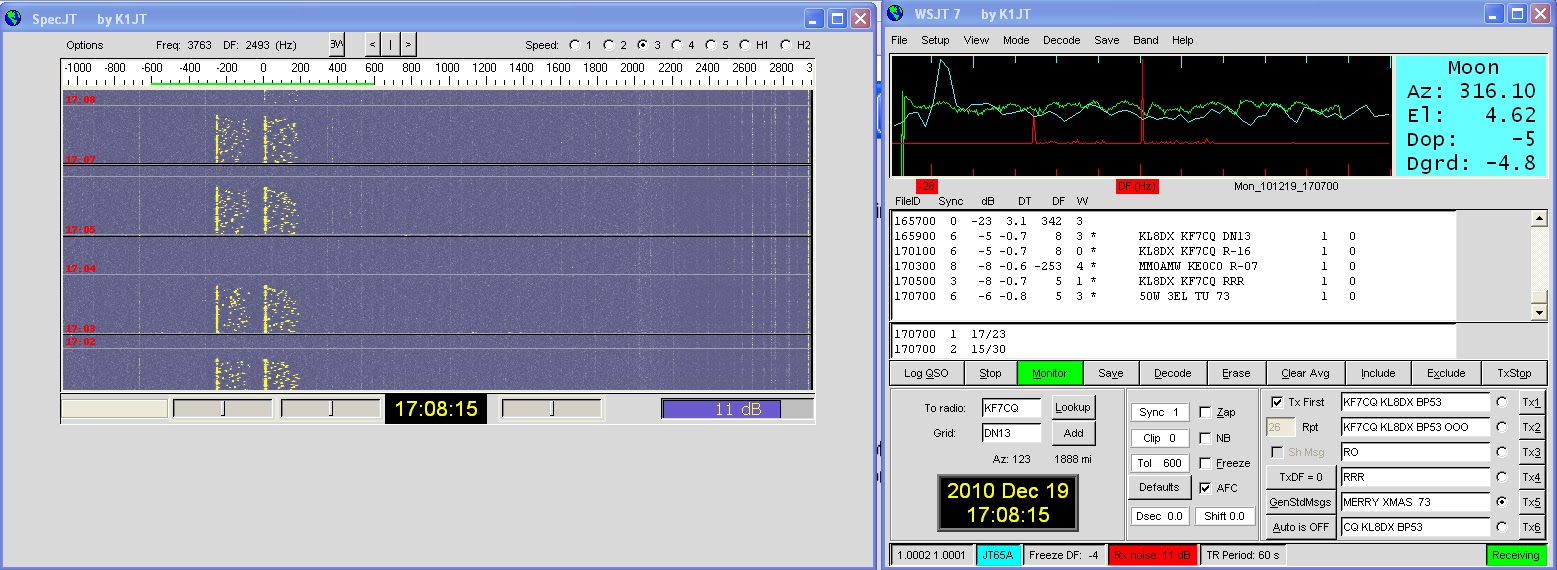
In looking at the activity this past weekend, there were a few contest type activities that I was interested in operating. But before I get into that, I decided to pull the JT65A software up again since it is a good weak signal mode and the bands don't seem to be open very long these days. Like every good ham radio operator, I read and re-read the directions but found one website to be a bit more informative. My biggest hang up was trying to figure out the software and learned a bit about right click and left clicking callsigns. Once I figured that out, things started to fall into place but not until after I made a contact with KF7CQ, or at least I think I did :0) Anyway, I plan to do a bit more with this mode in the coming weeks.

As far as the contests went, on the top of my list to participate in were the RAC Winter Contest which I participated in last year. This is a fun contest but I normally get skunked when it comes to getting all the Canadian Provinces. I have several VE stations I work on a very regular basis in the major contests so I like to try to send a point or two their way in their RAC. I ended up only making 82 contacts and catching 8 multipliers. I spent the last part of the contest chatting with my long time friend and old neighbor, KL1SF, on 20 meter SSB. I had to take advantage of the good band conditions and we closed 20 meters that evening of the 18th. We ended up chatting for 3 hours, which is the longest I have talked on SSB, ever!

After the RAC contest I also wanted to participate in the ARRL Rookie Roundup and the ARCI's Holiday Spirits Homebrew Sprint. I ended up working only a handful or stations calling "RR" in the Rookie Roundup and all were on CW (very cool). I then tuned up to the QRP section of 20 meters and started looking for QRP contacts. I switched rigs and fired up my Icom 703Plus and set the power at 5 watts. Now mind you, 100 watts can be ever so challenging from Alaska, so 5 watts might be a bit stressful for this operator. Either way, I have wanted to get into QRP operating so I'm reading "Patience 101 For QRP Operators" and I will let you know how it works. Inspired of course by wG0AT!

I set up my camera and shot a bit of video as I have thought about doing another Youtube video. I have one in the works and will hopefully work on it throughout the holidays. But anyhow, I found a few very strong signals operating the QRP contest and the very first was N4BP who just smokes into Alaska. I actually worked N4BP on 15 meters as well. The second strongest QRP signal went to K7TQ. I had a few others that were very close to 599 but these guys were rocking into AK that afternoon. But I have to say the highlight of this contest was my last QSO, HP1AC, who answered my CQ. As 20 meters faded, my  thought went out to one of the possible awards that ARCI offers, known as the KMPW Award. I wondered if the last contact with HP1AC would qualify me for that award. Thankfully, ARCI has an easy way to figure this out on their website. I keyed in the information for my contact with HP1AC. What'cha know, I squeaked by with 10 miles to spare! But hey, I'll take it! Needless to say, immediately after the contest I completed the award form and had it ready for the mornings mail run. Cool! I think I might like this QRP stuff after all. Making the 1000 Miles Per Watt Award kinda made my weekend. My next goal is to obviously make it much farther.  And speaking of QRP, I did chase a few Polar Bears around the bands this weekend! Highlight was working Ron, WB3AAL while he was portable and QRP from way on the other side of the US! I also worked John, N0EVH, Bear Den to Bear Den. But the coolest contact went to working Mike, KD9KC, who was portable atop the "Rough and Ready Hills" in New Mexico. I made a SSB contact with him on 15 meters.

So, even though I did not make hundreds of contacts, this weekend was productive and fun! With the short band openings these days, I will take all the propagation I can get! I think this wraps up my planned 2010 activity other than working a bit of PSK31 to complete my LOTW WAS as I'm down to only needing three more states.  I have a sked for one of those so I will probably be more active on that mode.

I want to take this time to wish any of my small number of readers a Merry Christmas and a very Happy New Year! I'm looking forward to Straight Key Night and then I will take part in the SKCC's K3Y Anniversary event. I really enjoy my Navy Flameproof keys and as long as my tired wrists can hack it, sending CW the old fashioned way is one of my favorites. I enjoy not only participating in the K3Y event as an operator but also as one chasing the call districts. I hope to do it QRP this year as well, so I have my work cut out for me. Look for me as K3Y/KL7 along with a few of my Alaskan SKCC neighbors who volunteer their operating time as well in the month of January. It's a month long event and sure to get you hooked on completing contacts with K3Y stations in all districts. Remember, CW is the Key to DX success! Just ask me, I'll tell ya.

Sunday, December 19, 2010

Reverse Beacon Network

I enjoy tuning around looking for beacons, especially on 10 meters but another great way to see if you have propagation is the Reverse Beacon Network where you can enter your callsign and see if any of the monitoring stations hear your signal when calling CQ. With Skimmers (a multi-channel CW decoder and analyzer) being the next step to DX Clusters, there are "ears" on pretty much all bands. From time to time, I call CQ and see if I am being heard by any of these. I won't get into the debate of Skim or not to Skim, but I find it a neat propagation tool. Here I took a look at where my signal was being heard on 10 meters. It lists what station was hearing me, my transmit frequency, the date and time, signal to noise ratio, and the speed I was sending CW. This is a band that is not open on a regular basis so it's often fun to listen for beacons and just give out a CQ. Just because a band is quiet does not mean that it's not open. I normally find more SSB activity on 10 meters than I do CW. Let's hope with the peak of this solar cycle that will someday change. But for now, major contests are a great time to score some extra QSO's on what to me is also another "magic band."