Saturday, July 31, 2010

QSL Bureau

Getting a drop from the ARRL bureau is always a nice surprise. Being active in Alaska, these envelopes can get pretty thick. Like a kid at Christmas, I thumb through all of the cards looking at each which has the personal touch of the owner. 

With the advent of electronic QSL'ing, many expected hard copy QSL's to dwindle to a drip. I still receive many hard copy QSL cards so the old fashioned way of QSL'ing is still alive and strong. I order 500 at a time and I normally like to change mine each time I order. I enjoy each and every QSL card I get no matter if it's a photo QSL card or just a stand alone stock card. I normally see a handful that really stand out
and I see who printed them for future reference. Most printers put their information on the cards and it's a great way to advertise your business to other hams. Some of the creativity that goes into these QSL cards is outstanding. And as with anything in the world today, the more colors or additions you put on a QSL card, the more expensive it can get.

I enjoy photography so I now place one of my own pictures on the front of my QSL card. Living in Alaska gives me many opportunities to take lots of photos of wildlife and landscapes and some of those photos (thanks to digital photography) are good enough for displaying on a QSL card that will end up being sent to thousands of hams worldwide. With the large amount of digital photos I have accumulated after living here for over 7 years, it can be a hard decision which to use on my next QSL card. I want to make it worthy of being posted in someone's shack or seen on the wall when a ham's photo appears in a magazine (you are like me and look in the background to see if you can spot your QSL card, right?). 
I have each and every QSL card that I have received since getting into ham radio well over 20 years ago. I also have a nice collection of airmail envelopes and stamps from direct QSL'ing. I don't do much direct QSL'ing (I answer all, but I don't send much out myself) as I rely on LOTW confirmations for most of my awards. Someday I will probably have to submit hard copy QSL's to add to my electronic confirmations but until that time, I let the cards flow to me rather then sending hoards out after each and every contest looking for confirmations of new countries or states. 
 I still get many SWL cards and I make sure to respond to each and every one of those as well. Most of those are received via the bureau. The bureau is a cheap way of sending and receiving QSL cards but it can take several years to receive a card via this route. Recently I got one of my cards returned to me with a stamp on it stating the ham was now a silent key. Some hams chose not to use their bureau but for us here in the US, it's just a matter of keeping envelopes at your incoming bureau. To send them, you can send several hundred cards for cheap which is still a great deal with today's economy.
I scanned these handful of QSL cards that I recently received which were only a few of the probably 150 I got in my envelope. I'm thankful for the volunteers who keep the bureau system alive and well. I do get many direct QSL card requests and as a stamp collector, this can be double fun. Getting a new state or country and then getting a new stamp to add to my collection of many years. 
 I have many favorites of the cards I have collected over the years and at some point in time, I have plans of putting together an album of these cards. They will represent all of the countries that I have worked over the years and also those cards that stood out above the rest either due to a memorable contact or just a beautiful photo on the front of the QSL card. I can only hope my QSL card is in someone's album or on someone's wall as to me, that is the ultimate culmination of a ham radio contact. 

Wednesday, July 28, 2010

Seward Funshine

Recently we headed to Seward, Alaska to spend a handful of camping days with our close friends, Sean and Mindy (KL1SF & KL1MF). Both will be leaving soon for the Grand Canyon, so we are squeezing in as much time together as possible before their August departure. With the purchase of our very first travel trailer, we put it to good use. It rained for most of the time (typical) but we did have one nice day! That was the day we gave ham radio a spin.

I configured my Buddipole as a vertical for 20 meters and mounted it off of the back of our trailer. Once I got it tuned, we heard a few signals, mostly out of Europe. The band was very poor and I expect it was due to a solar wind effect but since I did not have internet (other than my Blackberry) I did not go checking. Either way, it was fun to hook up and tune around looking for signals. In this photo, Sean, KL1SF was tuning around on 20 meter SSB listening for stations. I had to take the opportunity to snap a quick photo of the event.

We talk about summer but it is fast coming to an end. The fireweed is nearing the top and our days are getting shorter. As our local morning temperatures remind us that winter (maybe fall) is not far away. I have yet to get working on any of my antenna issues here at home and I hope I don't cut myself short. I do that every year but when summer arrives, we Alaskan's have to go play! Our winters are dark, long, and cold. We really don't want to be stuck working at home. I still have a goal of accomplishing some antenna work for the fall contest season but I also have some home improvement projects to get going on as well. We are already picking ripe blueberries and soon we will once again be driving to work in the darkness. Ham radio does not take a backseat to much in my world but when summer roles in, the shades to the shack get pulled and the "closed for the season" sign gets posted. Do you blame me?

Monday, July 5, 2010

Just in Case

Lately I have been spending a bit more time in the Alaskan backcountry. AT&T, ACS, or any other cellular phone company have coverage in most populated areas but the rest of this large state goes uncovered (excluding satellite). Being prepared is one thing you must do living here. I believe many of the Alaska reality shows have kinda showed that in one way or another. The key to survival here is knowledge, preparation, and communication. This is where ham radio kicks in for me.

After first moving to Alaska, being so far removed from civilization was a bit intimidating. I don't find the backcountry as intimidating anymore because I respect it. When things go wrong here, it's not a matter of will it happen, it's more a matter of when. 

Part of my survival kit is taking along my Icom 703 and portable antennas. It may take up a bit more space but no matter what happens, I will most likely have contact with the rest of the world. It gives me that extra piece of mind knowing that if something did go wrong, I have a means of getting help. And not only for me! I could easily drive up on an incident that required emergency personnel response. 

What made me think about this today was the fact that in viewing my station logbook, I have not made a contact in well over a month. Does that mean I have not done anything with ham radio? Nope, it's here and I have been enjoying the summer and spending time outdoors and ham radio has been with me all the time. That's the great thing about this hobby, you can take it with you where ever your travels lead. Think about it. A license that is good for ten years, the many modes and bands that we have, and it's there when YOU want or need it.  It's nice having that extra piece of mind when we are many miles from the nearest town or cellular tower.

Monday, June 28, 2010

Alaska Field Day Fun and Frustration

I had the privilege of once again operating at KL2R, north of Fairbanks, Alaska, for Field Day. Hosts N1TX and KL1BE went above and beyond yet again. Lots of fun and great food. 

For me, it started on Saturday morning when I set the alarm for 0530. Well, I smacked the snooze button for another ½ hour of sleep. Once up at 6:00 AM, I was out the door just a few minutes past 6:30 AM headed for Fairbanks. 

I arrived at Fairbanks at 8:40 AM first stopping at our local bank and then the gas station. I had made arrangements to pick up a visitor from Ohio (Rich, W8VK) at Fred Meyer's around 8:45 AM. Rich was there waiting for me and after fueling up, we headed toward ARS KL2R. I had a nice conversation with Rich and found it even more exciting that he was from Ohio! Being from Ohio myself, we had plenty to talk about on our short drive north of Fairbanks.

Upon our arrival, (around 9:30 AM) it was great meeting up with a few old friends that had arrived prior to us. After a few brief catching up and welcoming conversations, I headed for the operating area! Larry (N1TX) gave the run down of operating stations and modes planned.  This year, KL2R was operation as 7E! This in itself meant that we were operating 7 stations at the same time and operating on emergency power (generator, battery and solar for us). Dan, KL1JP, who I like to refer to as "Dan, the Solar Man" once again had his solar set up available. I am extremely interested in the folded solar panel on top of the cooler in the photo above. After seeing the portable solar panel and talking with Dan about it, I will be owning one very soon. 

I made myself comfortable at the 20 meter CW station and started to get acquainted with the Yaesu FT-950 radio. I operate Icom, but I must say I really like this transceiver, and the price is very reasonable. Once 10:00 AM arrived, I was off sending CQ Field Day from KL2R! 

The band was not very active and it was slow going. In looking at the space weather forecast for the weekend, I read that a solar wind was to buffet the earth on the 26th, so I figured the weekend would possibly be a challenge. Turns out, that was an understatement. 

20 meters never produced much in the way of activity until very late. It was slow and shy of steady for most of the day. I have to say that I extremely admire the other operators at KL2R. 20 was our most active band and it showed determination and dedication by the other operators to stick with bands that produced very little or nothing at all. I was getting frustrated at rates of 20 per hour, so I can only imagine what they were feeling. And yes, with the aurora level peaking at 9, that set the pace for the weekend.


There were many highlights for me personally, the first just being able to operate and meet several new hams I had not met before. Secondly, seeing Ken, W6HF, and Luci, KL1WE, making satellite contacts. I had operated satellites when I lived back in Ohio along with my sidekick, KL1SF. I have never even attempted them up here, as I sold my all mode UHF/VHF equipment upon arriving to Alaska (regrettably now). I actually took a small video of a contact that Ken and Luci made, which I hope to post in a Field Day 2010 video in the near future on my YouTube site. Not only was it cool that I got to see the action but Tammie Wilson, District 11's State House Representative stopped by and saw it as well (she also got the grand tour and got to see all of us in action)! Also, Elaine, KL6C (cool callsign, huh?) did a really cool educational activity with batteries. There was much more to enjoy, so check out KL2R's blog site for more detailed information once the dust settles. 


Getting back to the band, 20 meters really never came to full life, but toward the evening hours things appeared to pick up briefly. The spectrum scope showed more activity, but once again, our signal was not being heard very well due to the band conditions and the auroral influence. I left at 12:30 AM on Sunday morning and when I left, the only signals heard were a few from Asia. I had a stop to make at Wal-mart and then I was off for home, arriving back shortly after 3:30 AM. It was a long day, but well worth the drive. It is a contest format but in the end, friendship, food, and fun won it for me. Field Day is about a lot more than just band conditions, and that was proven this past weekend. In quoting the ARRL Field Day rules, the Field Day objective is "To work as many stations as possible on any and all amateur bands (excluding the 60, 30, 17, and 12-meter bands) and to learn to operate in abnormal situations in less than optimal conditions." Yep, mission accomplished at KL2R!

Monday, June 14, 2010

10 meters, finally!?

Started seeing several spots on the cluster today regarding PNW (Pacific North West) 10 meter propagation. I tuned my old 751A to 10 meters and I started to hear some faint SSB. I then headed down the band to scan for beacons. K6FRC was booming in as normal when 10's open (28.300). I heard and posted several other beacons. 

The 10 meter season begins for me on June 14th,2010. Starting off kinda weak but I'm hoping that many more openings are ahead. I was listening on 28.405 to a QSO that seemed to drag on forever, with no callsigns given. I can only guess as to their QTH. Either way, nice to see the band open once again. A good ten meter opening would be the only thing that would keep me from venturing outdoors on a day off, with plenty of sunshine!  Well, almost...

Tuesday, June 8, 2010

Scheduled Departure

Bittersweet evening as I pulled my trusty Icom 756PRO from the bench and gently rested it into the Astron box that I'm shipping it to Icom in. I worked a few stations in the NAQCC Sprint this evening and my last QSO was an SKCC QSO with W5VYH.  I purchased this rig new in September of 2000 and it has served me very well. I hope this rig lasts me at least another 10 years. The tuner has failed to function and that is the only problem. I am hoping that Icom can do a "once over" and make sure all is within specifications and alignment for me also. I will be glad to get it back and I am now relying on my backup rig, an Icom 751A and of course my QRP rig, Icom IC703 Plus.

Now, since this is my only high power 6 meter radio, I would advise all Alaska stations to listen close to 6 meters. I'm sure we will have great openings for hours now that my rig has been sent off to the shop. This is by far, the best rig I have ever owned and in my opinion, one of the best on CW and especially digital. Icom did right by this radio but their replacement is a bit out of my budget. I have owned Icom's since day one but my next rig may be something different. K3 comes to mind but rest assured, this 10 year old sweetheart will always have a home here. It has given more than it has received and like my wife, it spoils me. Travel safe my friend, for we will do CW once again.

Sunday, June 6, 2010

WPX Follow-up

I put together a small video and uploaded it to my YouTube page consisting of a few audio files and one video file of what the weekend sounded like to me. I'm new to the video making world but I think it's a great way to share experiences with others who are interested.

Thursday, June 3, 2010

CQ WW WPX CW Contest 2010

I was very excited to end the contest season and begin the summer season with the CQ World Wide WPX CW Contest. My CW speed leaves plenty to be desired but I enjoy getting into the mix. Often times, I am the lone KL8 floating around but since prefixes are what this contest is about, I think it flows a little more evenly and does not get as aggressive as other contests, for my station anyhow.

I really was not ready for the start of the contest and I did not start setting up Win-test until well after the contest started. Yep, already starting off on the wrong foot. Just lots going on that day as my daughter had left us that morning and with the lack of sleep and following her flights across the lower 48, I was destined for a late start. Either way, I finally got the software configured, the rig sending CW after being prompted by the keyboard and the amplifier warmed up. I began to work my way up the band and working stations that could hear me. This begins to tune my brain to the higher CW speeds (yep, I'm challenged at anything over easy) and gives me an idea of the current propagation path.

It just seemed that several were not really hearing me. Now mind you, I have a small station but I can usually shake the tree and get some apples to fall. Well, for a Friday night, the fight was to get someone to hear me. I was noticing an extra amount of flutter on signals so figured something solar was effecting my contest plans. Seems to be pretty normal lately. I worked my way up the band and finally picked out a spot in the nose bleed section above 14050 (14.058 to be exact). I called CQ and worked a few stations followed by a few more. Someone must have finally spotted me on the cluster as a few more showed up. A nice steady pace, nothing to write home about, but enough to keep me on my toes and having to sort a call out of a couple now and again. I stayed parked there until just a hair past 0300z. I was calling with little success so opted to search and pounce yet again. I did that for another hour with minimal results and ended up back to calling CQ. It was a struggle all the way. Very hard to keep focused when the bands are poor and the weather outside was so nice. I started to see fresh air in my weekend forecast.

After making a rough go of it on Friday night, I shut things down until Saturday morning. I found the conditions getting worse and by Saturday afternoon, I was looking for a reason as to why things were so poor. It did not take long for me to see why. A quick look at the Aurora Oval told the tale.
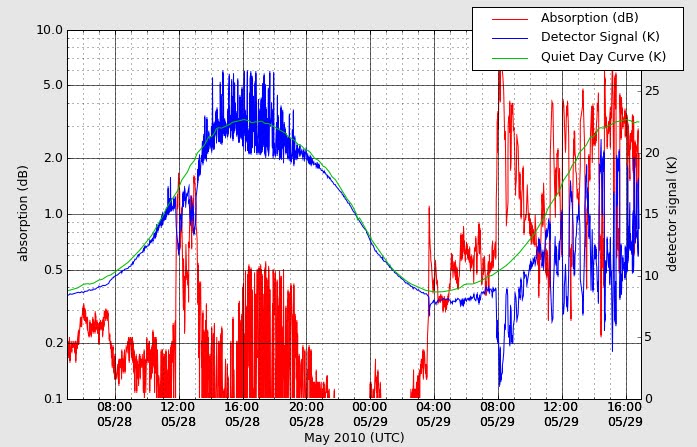
I did a bit more research and in checking HAARP, more very bad news was observed. The Riometer (at right) was seeing red and it was basically telling me to shut my rig down and enjoy the remainder of the weekend outdoors. Lots of absorption and as Saturday afternoon progressed, the less I could hear and the worse the bands got. I took a look at the HAARP to see what tale the Magnetometer was telling and it was the wildest I think I have seen, ever (below)!

By the time late Saturday afternoon arrived, I was able to tune the entire 20 meter band and not hear one signal, at all! I waved the white flag just a bit after 0200z. It was sad to see such conditions as I had hoped to beat my last years score. I did a 20 meter, single band entry and walked away with 510,884 points in the single operator category. When I checked my final score this year, I was just over 33K points with only 153 QSO's. Yep, very sad but it was not of my doing, or at least that is my excuse. My plans were once again effected by the solar influence that people living in northern latitudes can relate to. I have not read any detailed reports as to what the lower 48 heard and worked, but I did see mention of 10 meter activity. Well, I can only hope.

The contest season has wrapped up for me and I will be sending my Icom to the doctor for repairs. I plan on enjoying our summer (as I operated the contest, I could look out my window and see wildland fire not far away) as much as possible and do some portable operating. I hope to get some much needed antenna work done but that has been a project I have been working toward the last few summers. Our remodeling and weekend fun seems to trump the hobby work but I will once again, give it my best shot. With any luck, as autumn approaches, you will once again hear this small station warming up for yet another cold and dark winter. Ham radio in Alaska during those months just makes things a bit easier to tolerate. My wife might not agree but then again, I am not complaining that I have the shack all to myself! Watch for my YouTube video's on potential summer fun as KL8DX/p accompanied by my wonderful wife, KL8SU. See you on the bands, if the sun allows. I will be enjoying the sun however, the midnight sun that is! Damn, I love Alaska summers!